


To open a rental business in Ukraine, pick one niche, register as a group 3 FOP (sole proprietor) through Diia with a KVED code from group 77, buy 5–10 of your most in-demand items, prepare a contract and a way to take payments, and track bookings from your very first handover. You can start with UAH 20,000 if you choose a niche with inexpensive inventory.
Below is a step-by-step plan with Ukrainian numbers for 2026: taxes, pricing, deposits and first clients.
Is a rental business profitable in Ukraine
Yes, as long as your equipment actually goes out on rent instead of sitting in storage. Right now is a good time to start, for three reasons.
- Reconstruction. Crews and small contractors constantly need rotary hammers, scaffolding, concrete mixers and generators. Buying for a single job is expensive, so they rent.
- Events. Weddings, corporate parties and festivals are back, and with them demand for tents, furniture, lighting and sound.
- Tourism. The Carpathians and western Ukraine are welcoming tourists again, and they need skis, bikes and camping gear.
Renting has a few advantages over selling. You rent the same item dozens of times. If demand drops, the equipment is still yours rather than dead stock. And customers agree to a rental more easily than to a purchase.
The number that matters: utilization
Rental profit depends on how much of the time your equipment is out on rent. 60–70% utilization is already a very good result. Below 30% you barely cover costs, and above 80% it is time to buy more.
Example: a rotary hammer costs UAH 8,000 and you rent it for UAH 300 a day. If it is out 18 days out of 30, that is UAH 5,400 a month, so it pays for itself in under two months.
| Niche | Margin (approx.) | Seasonality |
|---|---|---|
| Construction tools | 40–60% | Spring–autumn |
| Event equipment | 50–70% | Spring–autumn |
| Sports and outdoor | 45–65% | Summer or winter, by niche |
| AV and media | 55–75% | Year-round |
| Household and baby items | 35–50% | Year-round |
Step 1: Pick a niche
The most common mistake at the start is buying a bit of everything. It works much better to pick one niche and become the most visible rental in your city for it. A narrow range makes availability easier to manage, terms easier to explain and promises easier to keep. You can expand later.
| Niche | Starting budget | Rental price | Demand |
|---|---|---|---|
| Construction tools | UAH 50,000–200,000 | UAH 200–800/day | High |
| Event equipment | UAH 100,000–500,000 | UAH 300–2,000/set | High, seasonal |
| Sports and outdoor | UAH 30,000–150,000 | UAH 150–600/day | Seasonal |
| AV and media | UAH 80,000–400,000 | UAH 500–3,000/day | Steady |
| Vehicles and heavy machinery | UAH 200,000–1,500,000 | UAH 500–3,000/day | Medium to high |
| Household and baby items | UAH 20,000–80,000 | UAH 100–400/day | Steady |
A few things to keep in mind:
- Event equipment needs transport and people for setup, so it is hard to run alone.
- AV gear is expensive and fragile, so a deposit and a contract are a must.
- Heavy machinery needs regular servicing and a large investment.
- Baby and household items have the lowest entry cost and rarely break.
How to check demand before you buy
- OLX. See how many rental listings there are in your city. Competitors mean demand exists. If there are none at all, the niche is either open or nobody needs it.
- Telegram groups. In local chats for builders, parents or photographers people often ask directly where to rent something. Read them for a few weeks.
- Instagram. Run a Stories poll: "Would you rent item for price?"
- Competitor bookings. Try to book their popular items for next weekend. If everything is taken, demand is bigger than supply.
Step 2: Register as a FOP
A FOP (individual entrepreneur) in Ukraine takes about 15 minutes to register through Diia. It is free, with no notary and no queues.
- Open the Diia app or diia.gov.ua
- Go to FOP registration
- Choose your KVED codes
- Choose your single tax group
- Sign the application with a qualified e-signature (KEP) or Diia.Signature
Registration usually takes effect the next business day.
Which KVED codes to choose
Rental businesses use codes from group 77. Add the main code for your niche plus 77.39 as a catch-all. Extra codes do no harm.
| KVED | What it covers |
|---|---|
| 77.11 | Renting passenger cars |
| 77.12 | Renting trucks |
| 77.21 | Renting sports and recreational goods |
| 77.29 | Renting other household goods |
| 77.31 | Renting agricultural machinery |
| 77.32 | Renting construction machinery and equipment |
| 77.33 | Renting office machinery and computers |
| 77.39 | Renting other machinery and equipment |
Which FOP group to choose
Group 3 of the single tax suits most rental businesses. The 2026 numbers:
- Tax: 5% of income (without VAT)
- Military levy: 1% of income
- Social contribution (ESV): UAH 1,902.34 a month, even with no income
- Income limit: UAH 10,091,049 a year
- Clients: anyone, including companies on the general tax system
Group 2 has a lower limit (UAH 7,211,598 a year) and only lets you work with individuals and other single tax payers. If construction companies or event agencies registered as LLCs will be among your clients, you will outgrow it quickly.
Group 1 does not work at all: renting out property is not allowed on it.
A comparison of FOP and LLC, tax limits and pitfalls is in a separate article: How to Officially Run a Rental Business in Ukraine (Ukrainian).
FOP bank account
Open a separate business account at Monobank, PrivatBank, PUMB or another bank, and keep it apart from your personal money. Bookkeeping gets simpler and the tax office has fewer questions.
Step 3: Buy your starting inventory
New or used
To test demand, used equipment is often the best choice: it is cheaper, and it hurts less if the niche does not work out. But the condition has to be flawless. A dirty or faulty item will damage your reputation faster than anything else.
Where to look:
- OLX and Facebook Marketplace: the widest choice of used gear, often from businesses that are closing
- Prom.ua: suppliers and small wholesale
- Epicentr, Leroy Merlin: tools and home equipment
- Brand distributors: worth contacting if you buy in bulk
- Bankruptcy auctions: equipment sometimes goes for 30–50% of market price
Start small and reinvest
Buy 5–10 of whatever people ask for most. A simple rule: only buy what will rent at least 3–4 times a month. Equipment that sits idle is frozen money. In the first months, reinvest 30–50% of revenue in new items your customers have already asked for.
Subrental when money is tight
You do not have to buy rare items. You can rent them from another rental business and rent them on to your customer with a markup. That way you offer a wider range without a big investment. In Requiply these items are tracked as subrentals: you see the supplier, the status of every purchase and how much you made on it after costs.
Step 4: Set prices and deposits
Where to start with the daily rate
A handy starting point: the daily rate is 1–2% of the equipment's value. A UAH 25,000 generator rents for UAH 250–500 a day. Cheap items rent for more than 2%, because handing out a drill takes as much time as handing out a plate compactor. So almost nothing should rent for less than UAH 100–150 a day.
Then compare your rate with OLX: the price has to be realistic for your city. Try it with your own numbers:
Rental Rate Calculator
The 1–2% rule, applied to your equipment
Per day
120–240
1–2% of value
Per week
≈ 630
×3.5 of the daily rate
Per month
≈ 1,800
×10 of the daily rate
Estimated revenue per year
16,430 USD
Pays for itself in
9 months
Estimates use the middle of the 1–2% corridor. Small tools usually price above it, heavy machines below it. Verify against your real costs and local market prices.
The full cost-based formula and the utilization math are in How to Price Equipment Rental.
Day, week, month
Longer rentals benefit both sides: the customer pays less per day, and you get several paid days from one handover. A working guide:
- Week: roughly 3–4 daily rates
- Month: roughly 10–12 daily rates
In Requiply you set these rates on an item once. From then on the system prices any booking for you.
Deposit
A deposit protects you better than any insurance.
- 50–100% of the value for expensive items
- A fixed amount of UAH 1,000–2,000 for cheaper equipment
- Returned after the condition check, in cash or by transfer
Seasonality
- Construction tools: peak from spring to autumn, slow in winter
- Ski gear: December to March
- Event equipment: May to September
- AV and media: steady all year
In season you can raise prices by 20–30%, and off season run promotions so the fleet does not sit idle.
Delivery and setup
Charge delivery as a separate line: UAH 50–200 per km or a flat rate within the city. If you bury it in the rental price, you never see what logistics really cost you.
Step 5: Protect your equipment
Rental agreement
Without a written agreement you have almost no protection if something is damaged or stolen. The agreement should include:
- details of both parties (full name, passport or tax number)
- the list of equipment with serial numbers and condition at handover
- the rental period
- the price and payment terms
- the deposit amount and how it is returned
- liability for damage, loss or late return
Agreements for up to 3 years do not need a notary or state registration; signatures of both parties are enough. You can generate a ready template for free in Equipment Rental Agreement: Template and Generator.
Once bookings pile up, filling in details by hand gets old. In Requiply the agreement, handover act and packing list are generated from the booking in one click, and the customer can sign the agreement with a KEP through Vchasno without coming to you.
Identify the customer
For expensive equipment, take a photo of the passport or ID card, a signed agreement and a deposit. Without all three, do not hand out anything worth more than a month of revenue.
Record condition at handover and return
A photo or short video before handover and after return settles most arguments about who damaged what.
Requiply has a handover and return checklist for this: you confirm every unit by hand or by scanning its barcode with a phone. If the customer did not bring everything back, you can mark a unit as still out, returned damaged or lost.
Leave 2–4 hours between rentals for inspection, cleaning and small repairs. With daily rentals this is no problem. For hourly rentals, build this buffer time into the schedule up front.
Insurance
Business insurance in Ukraine is less developed than in the EU, but UNIQA, PZU and ARX offer policies for small businesses. At the start, a contract, a deposit and photos cover most risks. Once your fleet passes UAH 500,000, talk to an insurance agent about property cover.
Step 6: Set up payments and tracking
How to take payments
- Bank transfer to your IBAN: the simplest option
- Plata by Mono: the most convenient online payment for individuals
- LiqPay: popular for both B2C and B2B
- WayForPay: a good alternative with payment links
- Cash: still common for construction and household rentals
About PRRO (software cash register). A group 3 FOP without a cash register can only accept bank transfers to their account by IBAN. Cash, card terminals and payment services such as LiqPay usually require a fiscal receipt. The rules change often, so check your situation with an accountant before you take the first payment.
Why spreadsheets and messengers stop working
Almost every rental starts with Excel and a chat. For 5–10 items that is enough. But at 20–30 items you start getting:
- double bookings of the same item for the same dates
- forgotten returns, because nobody wrote down the date
- payment confusion: who paid, who did not, where the deposit is
- no idea what earns money and what just takes up space
Requiply: rental management built for Ukraine
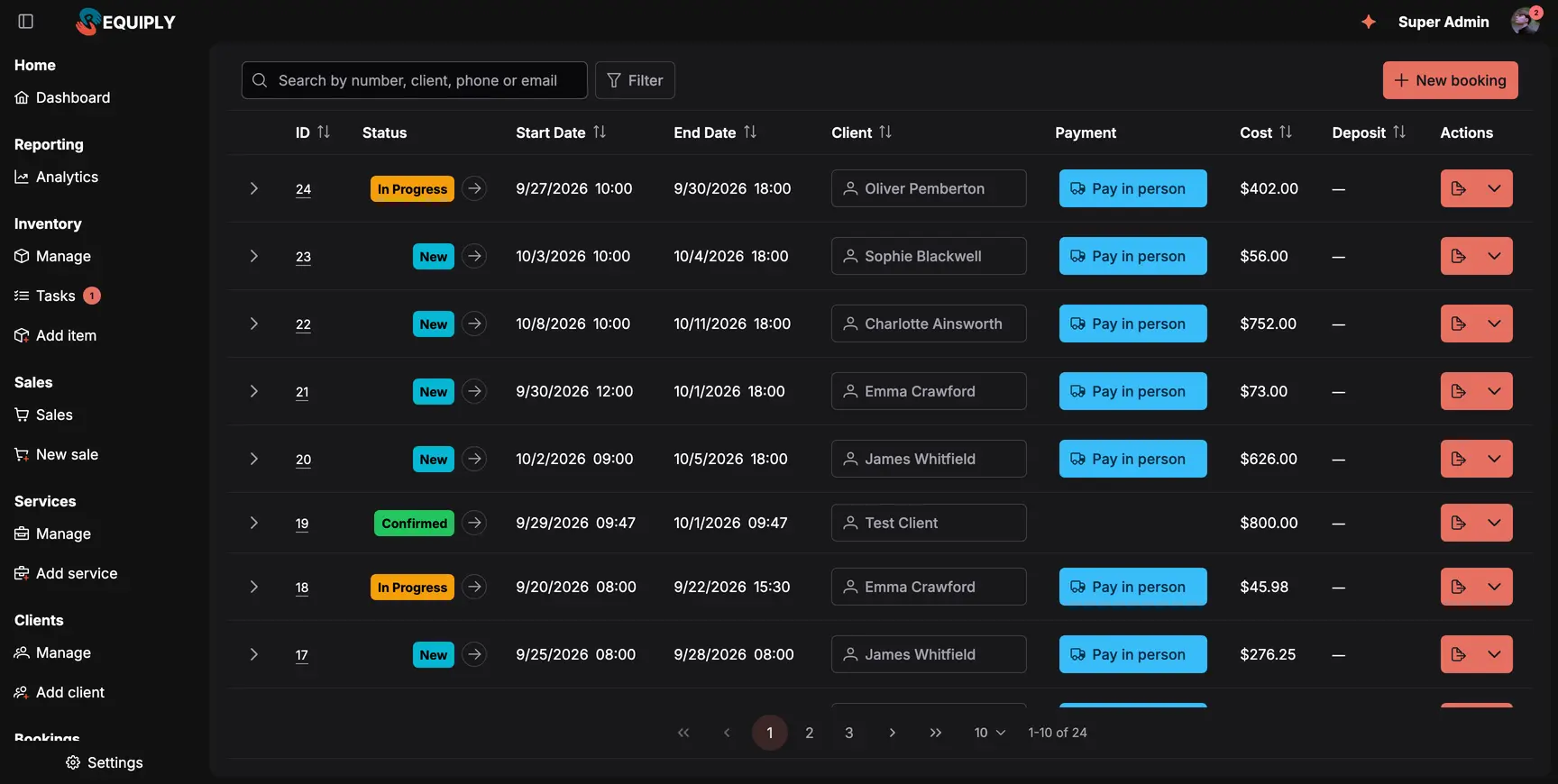
We build Requiply specifically for Ukrainian rental businesses. What it does today:
- Calendar and bookings with availability checks, so double bookings do not happen
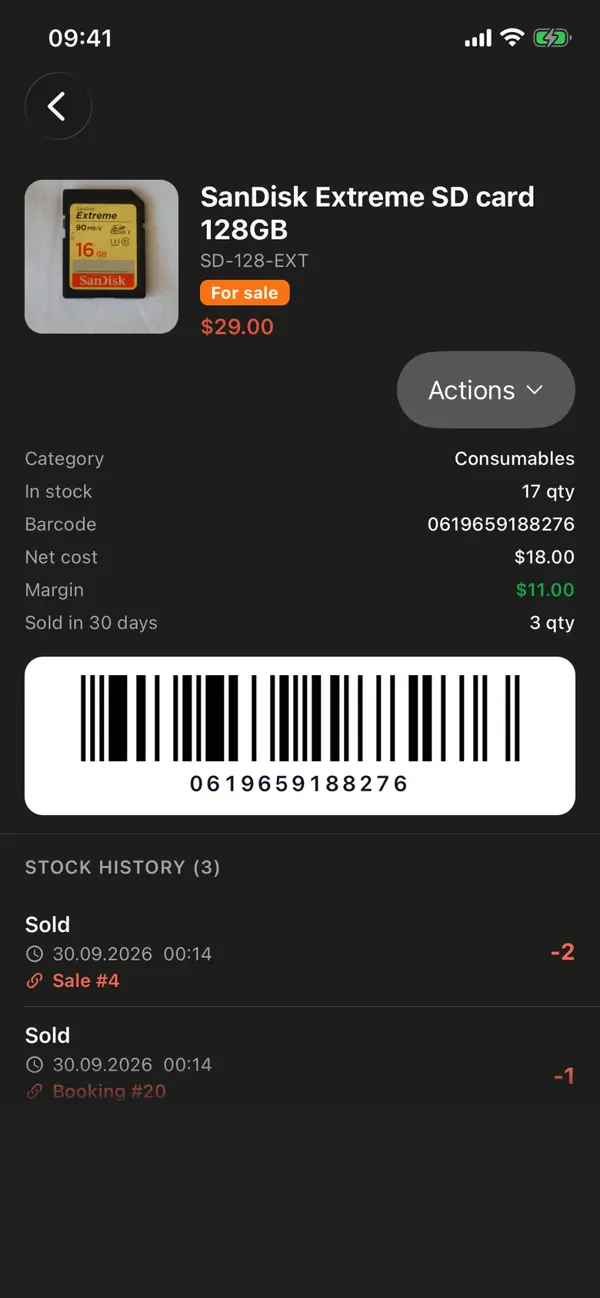
- Inventory by unit, with barcodes and printable labels
- Payments through Plata by Mono, LiqPay and WayForPay, deposits and one payment for a client's whole debt
- Agreements and acts from your own templates, signed through Vchasno
- Customer notifications via Telegram, SMS or Viber: confirmations, payment and return reminders
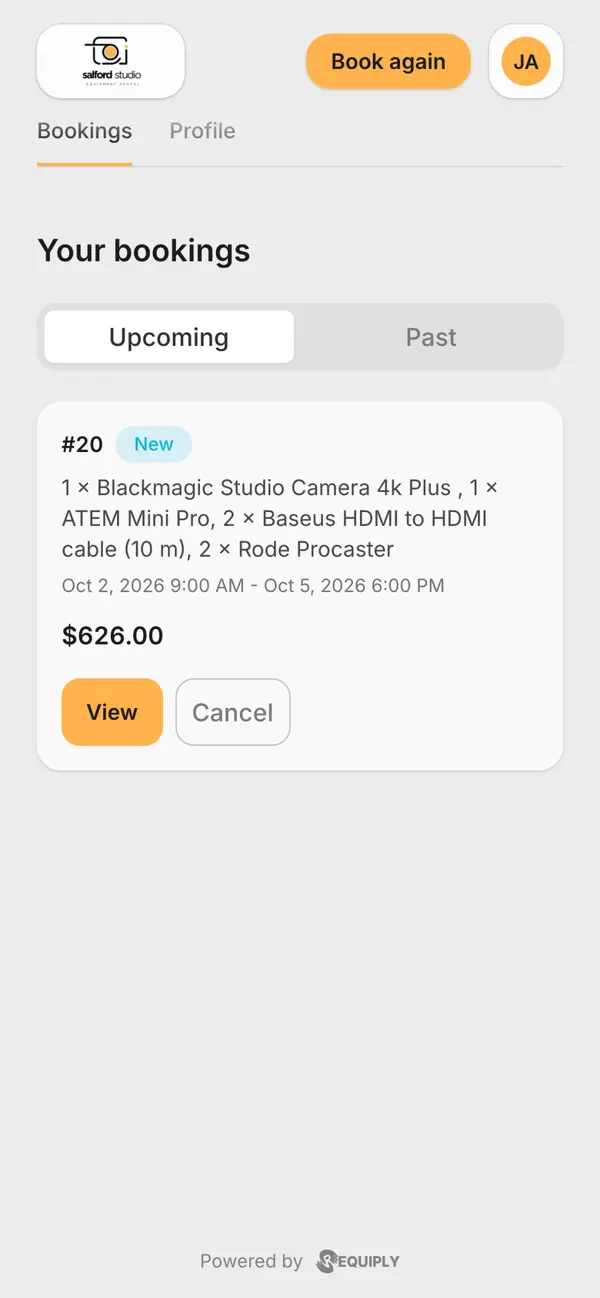
- A client portal where customers book on their own and follow their orders
- iOS and Android apps for handovers and returns in the warehouse
- An AI assistant that answers questions about the system and helps with setup
Pricing starts at €16 a month billed yearly (€19 monthly), and the first 14 days are free with no card required. Details are on the pricing page.
If the interface language does not matter to you, Booqable is an option too. There is an honest comparison in Booqable vs Requiply and What Rental Software to Choose.
Step 7: Find your first clients
A website where people can book
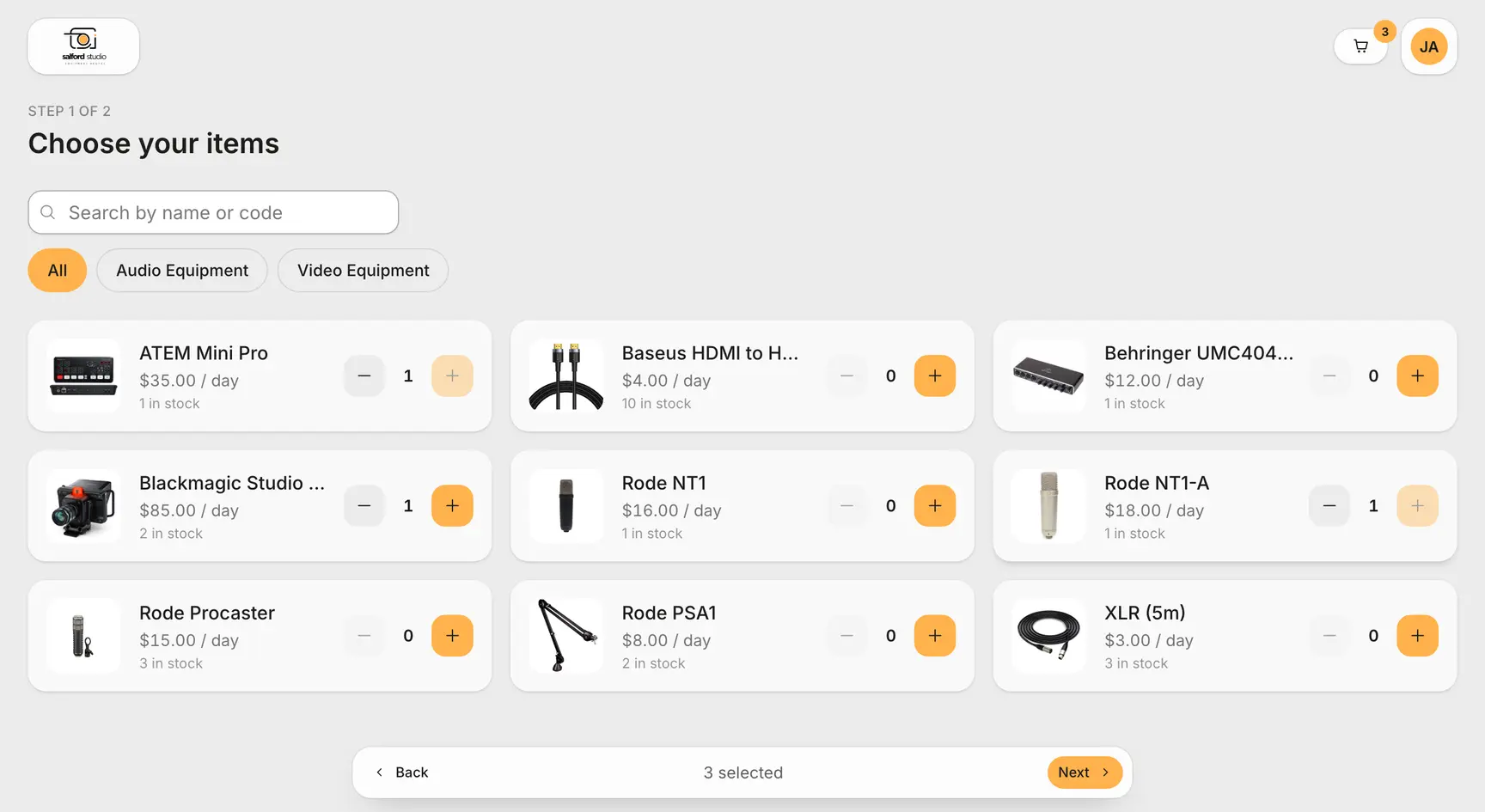
Customers want to see your range, check availability for their dates and book without calling. You do not need a developer for that: Requiply includes a client portal with a catalog, live availability, online payment and a personal account for each customer.


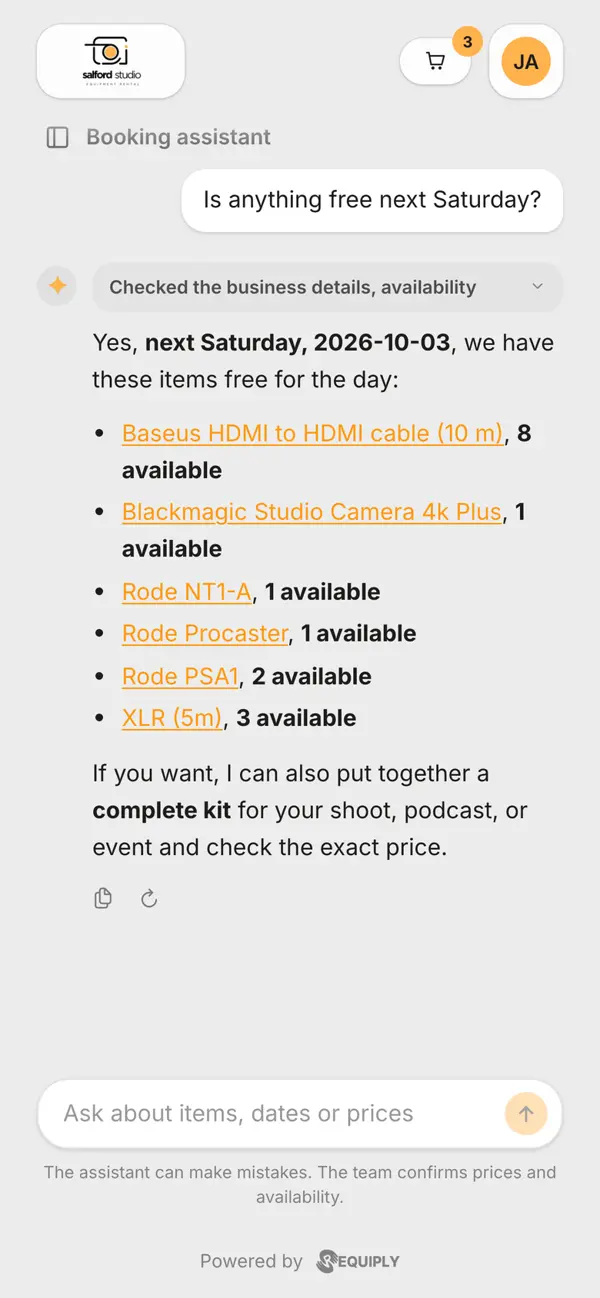
Even without a website, create a Google Business Profile. It is free, takes half an hour and puts you on Google Maps when people search "item rental city". Most small rentals skip it, so it is an easy edge.
Channels that work in Ukraine
- OLX. A must for rentals. One listing per category, real photos, a specific price and your service area.
- Instagram. Show equipment in action, handovers and reviews. Posting regularly matters more than perfect photos.
- Telegram groups. Do not spam. Answer when someone asks where to rent something.
- Facebook Marketplace. Another free place for listings, especially for construction and household rentals.
- Your network. First clients almost always come through people you know. Tell everyone about your rental and ask happy customers to recommend you.
- Partnerships. Event agencies, construction crews, photo studios, hotels and glampings can send you customers steadily.
How to get customers to come back
Winning a new customer always costs more than bringing back an old one. Simple things help:
- Reminders. A message the day before pickup and on the return day cuts late returns and missed pickups. In Requiply you can send them automatically through your own Telegram bot for free or via SMS and Viber.
- Answering calls fast. If you see a customer's history when they call, the conversation takes a minute. That is what the Binotel integration is for.
- A discount for regulars. A small discount for returning customers costs less than ads.
Name and recognition
Come up with a name people remember (not "Tool Rental No. 1"), make a simple logo in Canva and keep the same style across channels. People come back more readily to a rental they recognize.
Step 8: Scale
When to buy more equipment
- specific items are above 70% utilization for two months in a row
- you regularly turn customers away because everything is booked
- revenue lets you reinvest 30–50% without hurting cash flow
Once a quarter, look at what earns and what sits idle. Sell what stands still. Buy more of what is always out. Analytics in Requiply show revenue and profit per item, and the dashboard opens every morning on today's handovers, returns and money.
Your first hire
The first hire is usually for logistics: delivery, pickup, cleaning. That frees your time for sales and growth. Once several people use the system, give each their own rights through permission groups, and track delivery or setup subcontractors separately from your employees.
Extra services
Besides the rental itself, you can earn from:
- delivery and setup as a paid extra
- on-site support, especially for event equipment
- training and advice for complex equipment
- selling consumables: batteries, drill bits, discs, memory cards
The last one is especially easy, since the customer is already with you. In Requiply a sale is added to the booking and stock is written off automatically.
Working from the warehouse
When handovers come one after another, running back to a computer is a hassle. The Requiply app lets you check items out and in, scan barcodes and change bookings right from your phone.


Seasonal planning
- February–March: prepare for the construction and wedding season
- October–November: winter range (skis, generators, heaters)
- Off season: fleet maintenance, price review, team training
How much can you earn
Revenue = Number of units × Daily rate × Utilization × 30 days
Scenario 1: minimal start
- Investment: UAH 20,000–50,000
- Fleet: 12 small tools, household or baby items
- Rate: UAH 150 a day
- Utilization: 40%
- Revenue: ~UAH 21,600 a month
- Costs (taxes, ESV, maintenance, listings): ~UAH 8,000
- Net profit: ~UAH 13,500 a month
- Payback: 2–4 months
Scenario 2: a small tool or gear rental
- Investment: UAH 250,000–400,000
- Fleet: 50 units
- Rate: UAH 250 a day
- Utilization: 35% (realistic for the first year)
- Revenue: ~UAH 131,000 a month
- Costs (storage, a helper, transport, taxes, repairs): ~UAH 70,000
- Net profit: ~UAH 60,000 a month
- Payback: 5–7 months
Scenario 3: a full event or construction equipment rental
- Investment: UAH 1,500,000–3,000,000
- Fleet: 200+ units
- Rate: UAH 300 a day
- Utilization: 25% (events mostly happen on weekends)
- Revenue: ~UAH 450,000 a month
- Costs (team, storage, transport, taxes, repairs): ~UAH 300,000
- Net profit: ~UAH 150,000 a month
- Payback: 12–18 months
These are rough estimates for 2026. Real numbers depend on your niche, your city and how well you keep track of things. Utilization is usually lower in the first months, so keep a buffer.
Common beginner mistakes
1. Starting too broad. Ten rotary hammers and a reputation as the best tool rental in town will earn more than fifty different items.
2. Agreeing verbally. The first serious dispute without a contract can cost more than your whole starting fleet.
3. Skimping on maintenance. Dirty or worn equipment does not rent and hurts your reputation. Set aside 10–15% of revenue for repairs.
4. Tracking by hand for too long. At 20+ items a spreadsheet leads to double bookings, lost orders and money confusion.
5. Undercutting everyone. If you ignore depreciation, repairs and idle time, you are effectively renting at a loss.
6. Not being online. If you are not on Google and OLX, most customers do not know you exist.
7. Not measuring utilization. Without that number you cannot decide what to buy and what to sell.
8. Ignoring seasons. Buying skis on credit in spring and paying for them all summer is a bad idea. Plan purchases around the season.
Frequently asked questions
Want to see how all of this looks in practice? Try Requiply free for 14 days or book a short demo. We will help you set the system up for your rental.
Starting in Poland instead? See How to Start a Rental Business in Poland.
Legal note: tax and FOP registration details are current as of October 2026 and are a general guide. Legislation changes, so check the rules on diia.gov.ua and tax.gov.ua or consult an accountant.
- rental business
- Ukraine
- FOP
- equipment rental
- how to start
- KVED rental
- rental business Ukraine
- open rental shop
- rental in Ukraine
- rental business plan