


What's New in Requiply 1.2.7?
Every rental business runs on paperwork. A rental agreement at pickup. A handover act at delivery. A packing list for the warehouse. Requiply already generated the invoice. Everything else lived in a Word file that somebody retyped booking data into.
That ends here. Version 1.2.7 adds custom export templates: your own printable documents, built once as HTML, filled with real booking data, and downloaded as an A4 PDF from any booking.
The same release introduces the Requiply Assistant, the AI helper built into the app. It answers questions about how Requiply works using the official documentation. On the template editors it goes further and writes a complete agreement or confirmation email for you, then applies it to the form in one click.
1. Custom Export Templates: Your Documents, Your Layout
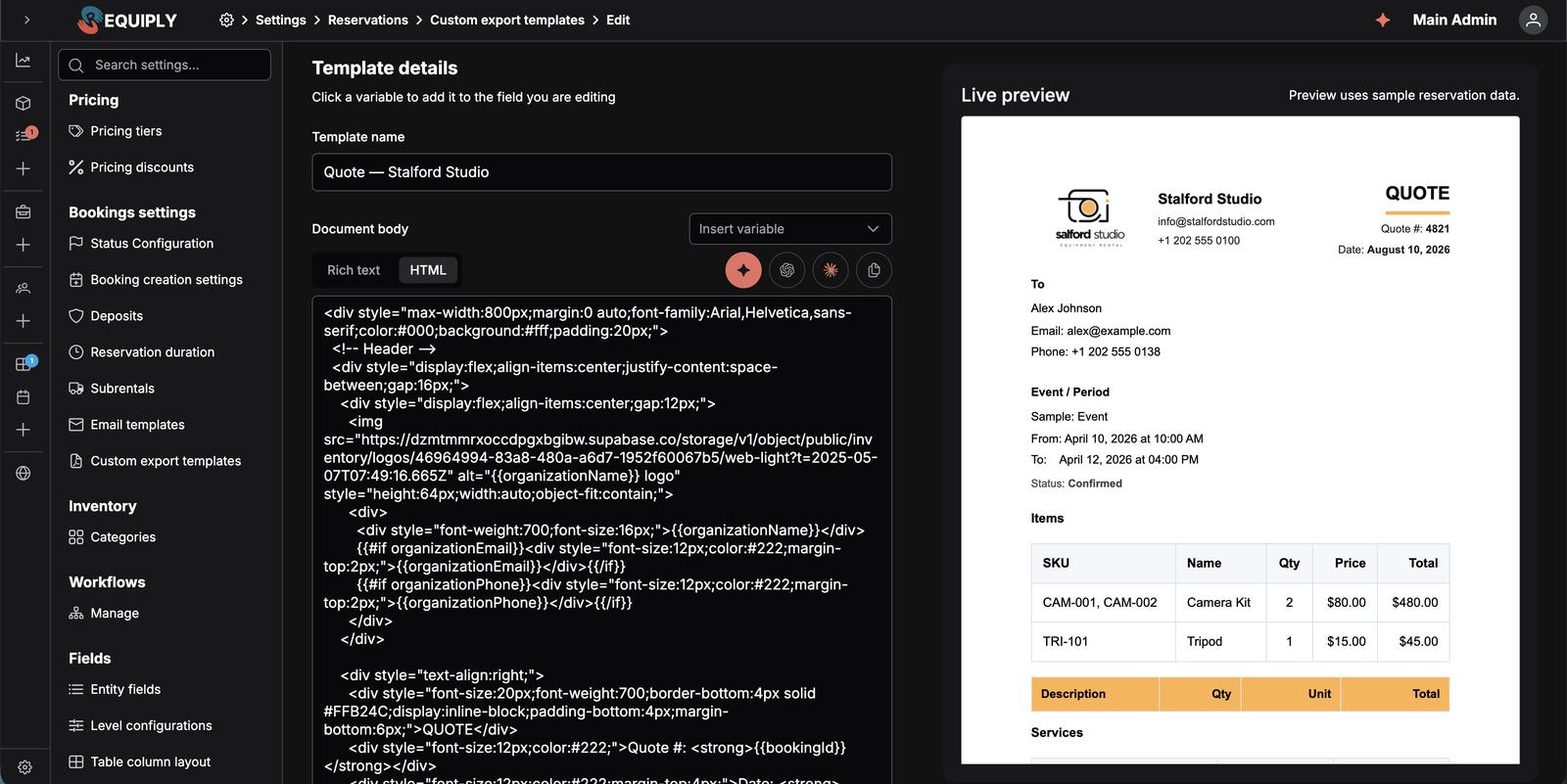
You'll find the new page under Settings → Bookings → Custom export templates. Requiply ships no built-in templates. You start with a blank list and build exactly the documents your business hands out.
Each template is a name plus a body. The body is plain HTML with {{variable}} tokens in it. At export time Requiply swaps every token for the booking's real data and renders the result to an A4 PDF with 15 mm margins.
What Changed
Creating and editing templates is admin only. Using them is not. Anyone who can open a booking can generate the document.
Practical Use Cases:
- Rental agreement: parties, booking period, equipment table, charges, deposit, responsibilities, signature lines
- Handover and return act: condition notes and acknowledgements for both directions of the trip
- Packing sheet: an internal picking list for the warehouse team, with no prices on it at all
- Damage report: pre-filled with the booking and client details before anyone starts writing
2. Variables: Everything Requiply Already Knows
A template is only useful if it fills itself. Export templates can read the whole booking.
Built-in tokens cover the client ({{clientName}}, {{clientEmail}}, {{clientPhone}}), the booking ({{bookingId}}, {{bookingStartDateTime}}, {{bookingEndDateTime}}, {{bookingStatus}}, {{bookingTotal}}, {{bookingDeposit}}, {{bookingTotalCharged}}), and your business ({{organizationName}}, {{organizationEmail}}, {{organizationPhone}}). {{documentDate}} prints today's date in your timezone.
Two tokens are special. {{bookingItems}} and {{bookingServices}} expand into complete HTML tables with SKU, name, quantity, price, and total columns. Put them on their own line and the equipment list builds itself.
Conditional Blocks
Export templates support one piece of logic, and it removes a whole category of near-identical templates:
{{#if bookingDeposit}}
  <p>Security deposit held: {{bookingDeposit}}</p>
{{/if}}
The block prints when the variable has a value and disappears entirely when it doesn't. Blocks can be nested. One agreement now covers deposit and deposit-free bookings, delivery and pickup, corporate and private clients.
What Changed
3. Custom Fields Become Template Variables
Requiply doesn't model every field your contracts need. A passport number. A VAT code. A delivery address. A licence number. Now you add them yourself, and they show up in your documents.
Every custom field configured on the Client, Booking, or Organization level is available as a variable, built from the field key with a level prefix:
| Entity level | Token pattern | Example |
|---|---|---|
| Client | {{clientField_<field key>}} | {{clientField_passport_number}} |
| Booking | {{bookingField_<field key>}} | {{bookingField_delivery_notes}} |
| Organization | {{organizationField_<field key>}} | {{organizationField_vat_number}} |
The Organization level is new in 1.2.7. Level configurations used to have four tabs (Item, Item Group, Client, Booking) and now has five. Unlike the other levels there is exactly one organization record per workspace, so these fields describe the business itself: VAT number, registration code, legal address, licence details.
You fill them in under Settings → Organization → Info, in a new Additional fields section below the logos. The section stays hidden until you configure at least one organization-level field.
What Changed
There's a new organization Phone field as well, exposed as {{organizationPhone}}, so your contact number stops being retyped into every template.
Practical Use Cases:
- Legal identity in one place: store your VAT and registration numbers once on the organization, and every contract prints them correctly
- Passport and licence capture: add the field to the client level, fill it once, and your agreement is complete without a second form
- Delivery instructions: a booking-level field that flows straight into the handover act the driver carries
4. One Click from a Booking
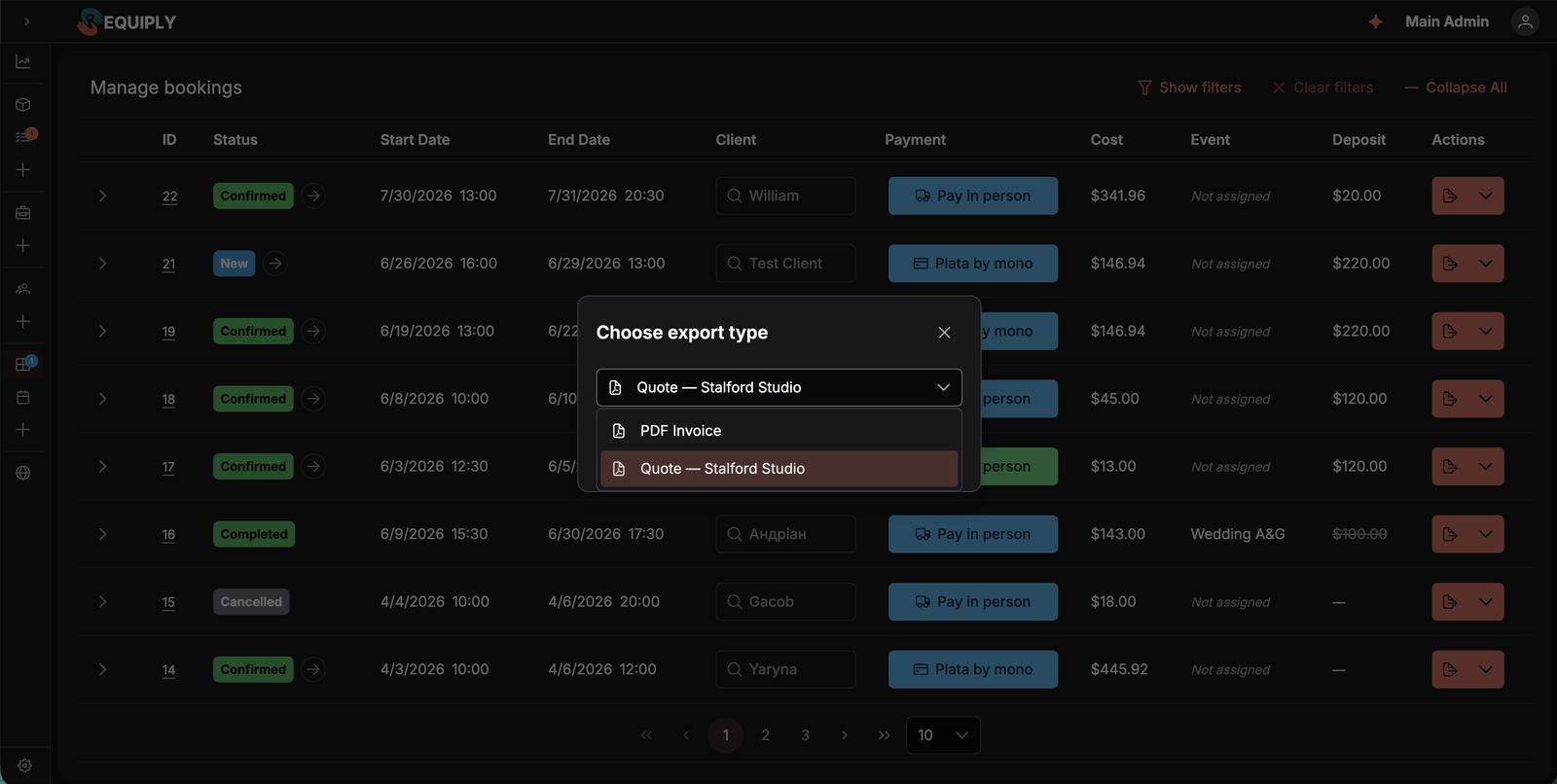
Templates go where the work already happens. The Export dialog on a booking, reachable from the row action on Manage bookings or from the booking detail page, is now headed Choose export type. It lists PDF Invoice first, then every template you've designed, by name.
Pick one, confirm, and the filled-in PDF downloads as <template name>-<booking number>.pdf. Staff never touch HTML. They pick the document by the name you gave it.
That's why the name matters. Call it Rental agreement, Handover act, Packing list. Something the team recognizes at pickup with a client waiting.
5. Meet the Requiply Assistant
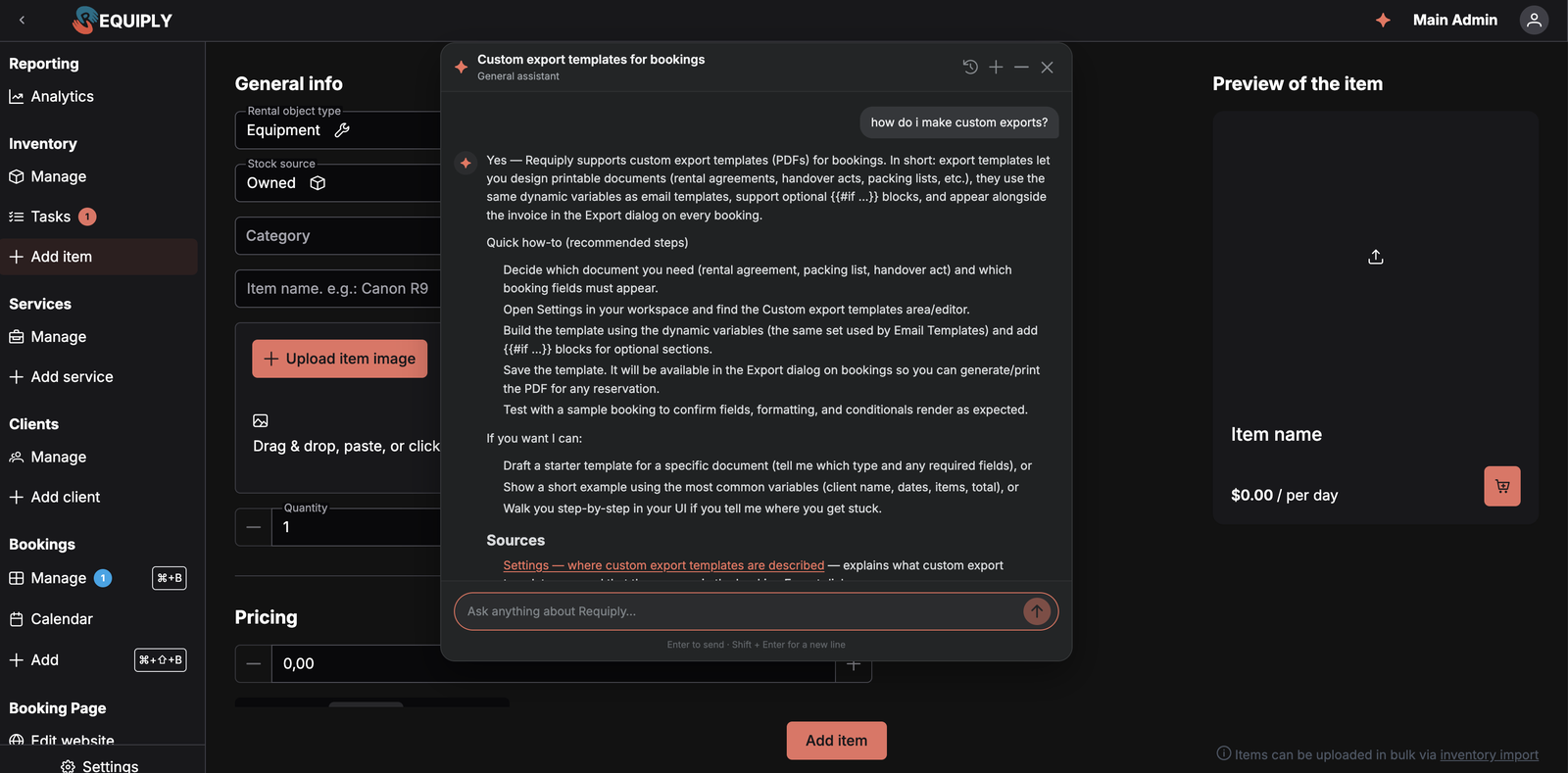
Building an HTML contract from an empty textarea is a lot to ask. So 1.2.7 also ships help.
The Requiply Assistant lives behind the star icon in the top bar, on every page of the app and in Settings. Ask it in plain language how something works. It searches the Requiply documentation, reads the relevant pages, and answers with links to them.
It opens as a floating panel over the page you're on, so a question never costs you your place in a half-filled form. Drag it aside, minimize it to its header, or close it and pick the conversation back up from history.
What Changed
One important boundary. The assistant answers from the documentation, not from your records. It cannot look up a specific booking, check availability, or read your inventory. For AI that works with your live data, connect Claude or ChatGPT to your organization over MCP under Settings → Integrations → AI. Plenty of businesses will want both.
The assistant runs on your organization's AI credit balance, shared with Requiply's other AI features. When credits run out it stops answering until you top up.
6. The Assistant as a Designer
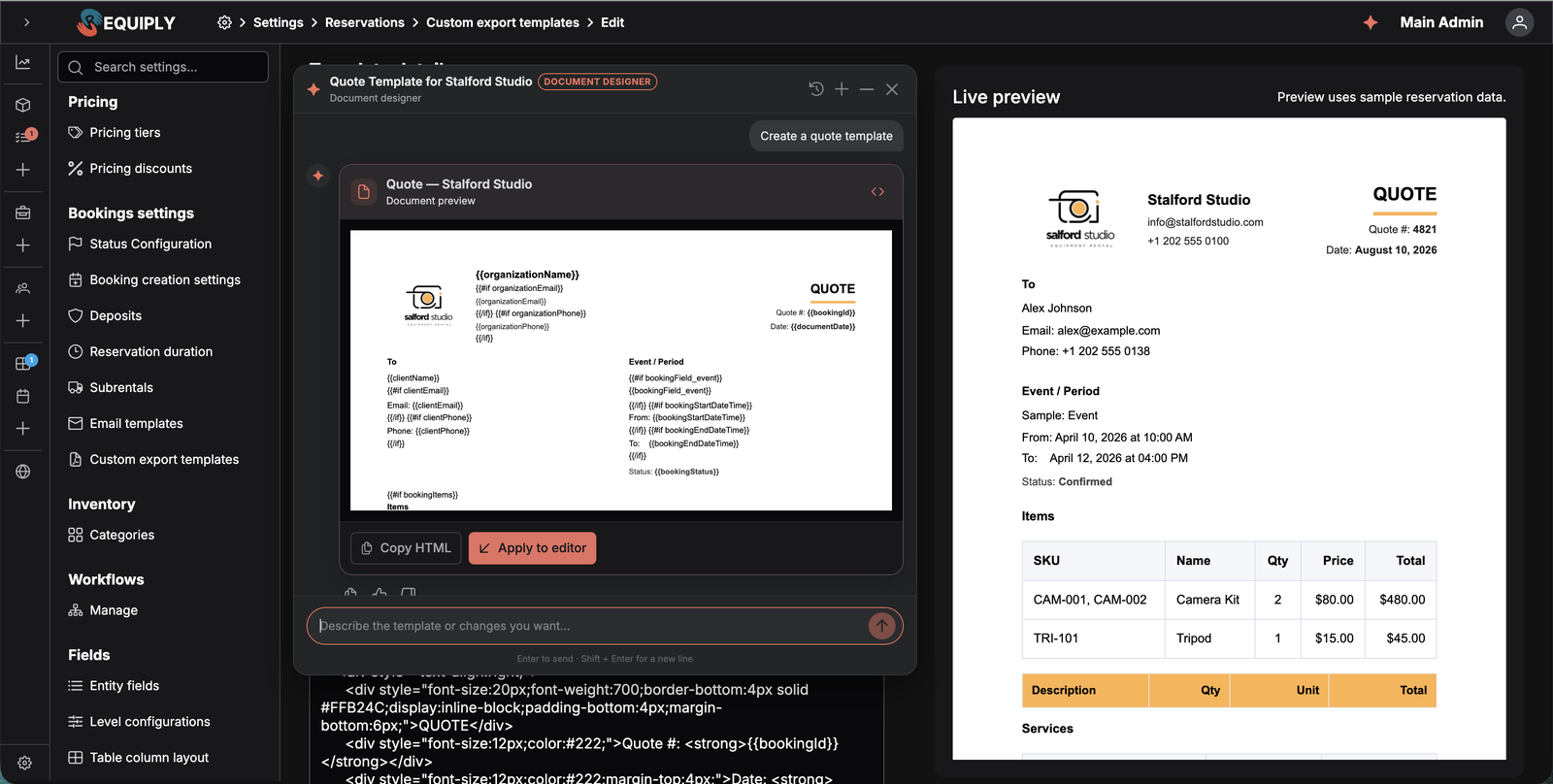
On the email and export template editors, the assistant changes job. A Create with Requiply Assistant button opens it in designer mode, and it arrives already knowing three things: the variables available on that page, the draft currently in your editor, and your organization's name, brand color, and logo.
Ask for a rental agreement. Ask for a booking confirmation email. Ask it to translate what you already wrote, or shorten it, or add a cancellation clause. What comes back is not a wall of HTML. It's a card with a rendered preview, a code toggle, copy buttons, and Apply to editor.
Applying an email draft fills in the subject and body. Applying a document draft fills in the template name and body and switches the editor to HTML mode. Nothing is saved to your organization until you press Save yourself.
What Changed
The older AI buttons are still there. Open in ChatGPT, Open in Claude, and Copy prompt open an external model with a prompt that explains every Requiply variable. Those remain copy-and-paste round trips. Only the Requiply Assistant writes back into the form.
Practical Use Cases:
- Your first agreement in an afternoon: start from the Draft a rental agreement starter, apply it, then edit the clauses that are specific to your business
- A second language: open your existing template, ask for a translation, and save it as a second template so you keep both
- Onboarding a new manager: point them at the star icon instead of writing an internal wiki
7. Smaller Improvements
Not everything in a release needs a section of its own.
Frequently Asked Questions
What's Next?
Version 1.2.7 hands you the two halves of the same job. The template engine that turns a booking into your document, and an assistant that writes the first draft of it.
Here's what we're building next:
Exports beyond bookings. Custom templates currently start from a booking. The same engine is heading for inventory, clients, and reports, so a supplier list, a client card, or a period report can be a document you designed rather than a layout we chose.
Have questions or suggestions? Write to us at info@requiply.com. We'd especially love to see the first document you build, and to hear which one your business needed most.
- Requiply version
- requiply
- export templates
- custom documents
- rental agreement
- handover act
- custom fields
- template variables
- ai assistant
- knowledge base
- email templates
- rental software