


To open a rental business in Poland, pick one niche, register a sole proprietorship (JDG) in CEIDG online for free with a PKD code from division 77, choose a tax form (most small rentals pick the 8.5% ryczałt), use the six months of ZUS relief, buy 5–10 of your most requested items, sign every rental with an agreement and a deposit, and take payments by BLIK or bank transfer. A small tool or household rental can start with about PLN 10,000–20,000.
Below is a step-by-step plan with Polish numbers for 2026: registration, taxes, ZUS, pricing, deposits and first clients. If you are a Ukrainian citizen living in Poland, there is a section on what changed for you in March 2026.
Is a rental business profitable in Poland
Yes, if your equipment actually goes out on rent instead of sitting in storage. Poland has a few things going for it.
- Renovation and construction. Poles renovate a lot and like to do it themselves, and small crews rarely buy a plate compactor for one job. Tool rental is an everyday service here, from big chains to one-person shops.
- Events. The wedding and outdoor event season runs from May to September and drives demand for tents, furniture, lighting and sound.
- Tourism and sport. Skis in the Tatras and Beskidy in winter, bikes, kayaks and SUP boards on the Masurian lakes and the Baltic coast in summer.
- A large Ukrainian business community. Ukrainians have founded more than 123,000 businesses in Poland since 2022, and about a quarter of Ukrainian sole proprietorships work in construction (PIE, 2026). Those crews need tools, and many prefer to deal in their own language.
The number that matters: utilization
Rental profit depends on how much of the time your equipment is out. 60–70% utilization is already a very good result. Below 30% you barely cover costs, above 80% it is time to buy more.
Example: a rotary hammer costs about PLN 2,500 and rents in Poland for PLN 110–130 a day. If it is out 15 days out of 30, that is around PLN 1,700 a month, so it pays for itself in about six weeks.
Step 1: Pick a niche
The most common mistake is buying a bit of everything. Pick one niche and become the most visible rental for it in your city. A narrow range is easier to keep available, easier to explain and easier to keep promises on. You can expand later.
| Niche | Starting budget | Typical price | Season |
|---|---|---|---|
| Construction and renovation tools | PLN 15,000–60,000 | PLN 70–210/day | March–November |
| Event equipment (tents, furniture, light) | PLN 30,000–150,000 | PLN 300–3,000/event | May–September |
| Sports and outdoor (skis, bikes, SUP) | PLN 10,000–50,000 | PLN 40–150/day | Winter or summer |
| Photo, video and audio | PLN 20,000–120,000 | PLN 100–400/day | Year-round |
| Machinery (mini excavators, lifts) | PLN 100,000–600,000 | PLN 600–1,200/day | March–November |
| Household and baby items | PLN 5,000–25,000 | PLN 20–80/day | Year-round |
Prices are indicative and based on 2026 price lists of Polish rentals (kb.pl, resort rentals, OLX). For reference: a plate compactor goes for PLN 170–210 a day, a mini excavator for PLN 640–720, a full ski set for PLN 40–90.
A few things to keep in mind:
- Event equipment needs a van and people for setup, so it is hard to run alone.
- Photo and video gear is expensive and fragile, so a deposit and a contract are a must.
- Machinery needs servicing, transport and often an operator.
- Household and baby items (carpet cleaners, strollers, car seats) have the lowest entry cost and rarely break.
How to check demand before you buy
- OLX.pl. It has a dedicated Wypożyczalnia (rental) category. Count the listings in your city and look at the prices. Competitors mean demand exists.
- Google Maps. Search "wypożyczalnia item city". Few results with weak reviews is an opening.
- Facebook groups. Local renovation groups, parents' groups and Ukrainian community groups regularly ask where to rent something. Read them for a few weeks.
- Competitor bookings. Try to book their popular items for next weekend. If everything is taken, demand is bigger than supply.
Step 2: Register your business
Can you test without registering?
Poland allows unregistered activity (działalność nierejestrowana). In 2026 you can earn up to PLN 10,813.50 per quarter (225% of the minimum wage) without a business registration and without ZUS. It is a good way to rent out a few items and see whether anyone calls. It is only available if you have not run a business in the last 60 months, and once you go over the limit you have 7 days to register a business.
Registering a JDG
A sole proprietorship (jednoosobowa działalność gospodarcza, JDG) is registered in CEIDG through biznes.gov.pl. It is free and takes about 20–30 minutes.
- Log in with Profil Zaufany, an e-ID card (e-dowód) or your online bank
- Fill in the CEIDG-1 form: name, address, PKD codes, start date
- Choose your tax form (see below)
- Choose your ZUS option, the same form passes it to ZUS
- Sign and submit
One application registers you with the tax office, ZUS and the statistics office (you get a NIP and a REGON). You need a PESEL number. You can also file the same form in person at any town hall (urząd gminy).
Who can register. Polish and EU citizens, and non-EU citizens with a qualifying residence title: permanent residence, EU long-term residence, certain temporary residence permits, refugee status or subsidiary protection, a Karta Polaka, or the CUKR card. Ukrainian citizens have special rules, explained below.
Which PKD codes to choose
Poland moved to the new PKD 2025 classification. Rental codes are in division 77. Add the code for your main niche and 77.39.Z as a catch-all. PKD codes do not change your taxes or ZUS, so extra codes do no harm.
| PKD 2025 | What it covers |
|---|---|
| 77.11.Z | Renting cars and light vehicles |
| 77.12.Z | Renting trucks |
| 77.21.Z | Renting sports and recreational equipment (skis, bikes, kayaks) |
| 77.22.Z | Renting other personal and household goods (was 77.29.Z in PKD 2007) |
| 77.31.Z | Renting agricultural machinery |
| 77.32.Z | Renting construction machinery and equipment |
| 77.33.Z | Renting office machinery and computers |
| 77.39.Z | Renting other machinery, equipment and goods (events, AV, everything else) |
Which tax form to choose
This is the biggest decision. You pick it at registration and can change it once a year.
| Tax form | Income tax | Health contribution 2026 | Fits when |
|---|---|---|---|
| Ryczałt (lump sum) | 8.5% of revenue | PLN 551.87 / 919.78 / 1,655.60 a month, for annual revenue up to 60k / up to 300k / above | Costs are low |
| Tax scale (skala) | 12% of profit up to PLN 120,000, 32% above, first PLN 30,000 tax-free | 9% of profit, at least PLN 432.54 | Profit is low or you invest heavily |
| Flat tax (liniowy) | 19% of profit | 4.9% of profit, at least PLN 432.54 | Profit is high |
Most small rentals pick ryczałt: one rate, simple bookkeeping. Two things to know:
- Ryczałt taxes revenue, not profit. You cannot deduct the equipment you buy. A rental spends most of its money on equipment in the first year, so on the tax scale that year can show little or no profit. Equipment worth up to PLN 10,000 can be written off at once, more expensive items are depreciated. Run both options with an accountant before you choose.
- The ryczałt rate for equipment rental is not settled. Most accountants apply 8.5%, but a July 2025 tax interpretation treated equipment rental as "najem": 8.5% up to PLN 100,000 of revenue a year and 12.5% above. If you expect more than that, ask your accountant or apply for your own interpretation.
ZUS: what you pay in the first years
Polish social contributions start low and grow over time:
| Period | What you pay to ZUS each month |
|---|---|
| Months 1–6 | Ulga na start: no social contributions, only health |
| Next 24 months | Preferential ZUS: about PLN 456 social (with voluntary sickness insurance) plus health |
| After that | Mały ZUS Plus if last year's revenue was under PLN 120,000 (36 months in every 60), otherwise full ZUS of about PLN 1,927 plus health |
Health contribution is paid from day one and depends on your tax form (see the table above). From February 2026 the minimum on the tax scale and flat tax is PLN 432.54 a month. Current amounts are always on zus.pl.
VAT, cash register and e-invoices
- VAT. You are exempt until your sales reach PLN 200,000 a year. Consumers then pay you less than they would pay a VAT-registered competitor, whose price includes 23% VAT. If most of your clients are companies, they may prefer a VAT invoice, so voluntary registration can make sense.
- Cash register (kasa fiskalna). Sales to individuals are exempt up to PLN 20,000 a year. Above that you need an online cash register, unless the customer pays the whole amount to your bank account and your records show which rental it was for. That exemption does not cover cash or card terminal payments.
- KSeF. Poland's national e-invoicing system is mandatory for invoices to businesses, VAT-exempt sellers included. If your invoices to companies stay under PLN 10,000 a month, you can issue them outside KSeF until the end of 2026. From 1 January 2027 everyone uses it. Invoices to consumers do not have to go through KSeF.
Bank account and accounting
Open a separate business account. Most Polish banks (PKO BP, mBank, ING, Santander, Pekao) offer free accounts for a new JDG. For bookkeeping, an online accountant costs about PLN 150–300 a month, or you can do it yourself in apps like inFakt, wFirma or iFirma. There are also accountants who work in Ukrainian and English.
If you are a Ukrainian citizen in Poland
Since 5 March 2026 the old special act for Ukrainians is being phased out, and the rules for running a business changed:
- You have PESEL with UKR status (temporary protection). You can register and run a JDG on the same terms as Polish citizens. In CEIDG there is a separate statement to tick that you hold PESEL UKR and benefit from temporary protection. The EU has extended temporary protection until 4 March 2028.
- You registered your JDG before 4 March 2026. You can keep running it as long as your stay in Poland is legal.
- You hold a CUKR card or another residence permit. You register like any other non-EU citizen with a qualifying residence title. The CUKR card gives the same access to business as Polish citizens.
If your stay stops being legal, the business is removed from CEIDG. If your plans in Poland are long term, apply for a CUKR card or another residence permit in time.
Keeping a Ukrainian FOP. If you live in Poland for more than 183 days a year or your centre of life is here, you are most likely a Polish tax resident and owe tax in Poland on worldwide income. The single tax paid by a Ukrainian FOP is usually not credited in Poland, so there is a real risk of paying twice. Talk to an accountant who knows both systems before you run a rental through a Ukrainian FOP while living in Poland.
Step 3: Buy your starting inventory
New or used
To test demand, used equipment is often the best start: it is cheaper, and it hurts less if the niche does not work out. But the condition has to be flawless. A dirty or faulty item damages your reputation faster than anything.
Where to look:
- OLX.pl, Allegro and Facebook Marketplace: the widest choice of used gear, often from businesses that are closing
- Castorama, Leroy Merlin, OBI: tools and garden equipment
- Brand distributors: worth contacting if you buy several units
- Bailiff and bankruptcy auctions (licytacje komornicze, syndyk): equipment sometimes goes well below market price
Start small and reinvest
Buy 5–10 of whatever people ask for most. A simple rule: only buy what will rent at least 3–4 times a month. Equipment that sits idle is frozen money. In the first months, reinvest 30–50% of revenue in items customers have already asked for.
Subrental when money is tight
You do not have to buy rare items. Rent them from a bigger rental and rent them on to your customer with a markup. In Requiply these items are tracked as subrentals: you see the supplier, the status of every purchase and what you made on it after costs.
Step 4: Set prices and deposits
Where to start with the daily rate
For expensive equipment a handy rule is 1–2% of its value per day. Cheap tools rent for more, often 3–5% of their price, because handing out a drill takes as much time as handing out a compactor. Then check your rate against OLX and local rentals. Try it with your own numbers:
Rental Rate Calculator
The 1–2% rule, applied to your equipment
Per day
100–200
1–2% of value
Per week
≈ 525
×3.5 of the daily rate
Per month
≈ 1,500
×10 of the daily rate
Estimated revenue per year
13,690 zł
Pays for itself in
9 months
Estimates use the middle of the 1–2% corridor. Small tools usually price above it, heavy machines below it. Verify against your real costs and local market prices.
The full cost-based formula is in How to Price Equipment Rental.
Day, weekend, week, month
- Weekend: many Polish tool rentals let customers pick up on Friday evening and return on Monday morning for one or 1.5 daily rates. It fills idle weekends.
- Week: roughly 3–4 daily rates
- Month: roughly 10–12 daily rates
In Requiply you set these rates on an item once, and every booking is priced for you.
Deposit (kaucja)
A deposit protects you better than any insurance.
- 50–100% of the value for expensive items
- A fixed amount of PLN 200–1,000 for cheaper tools
- Returned after the condition check, in cash or by transfer
For companies, many rentals waive the deposit and invoice on terms instead, once the client has a track record.
Seasonality
- Construction tools: March to November, quiet in winter
- Skis: December to March
- Events and weddings: May to September
- Bikes, kayaks, SUP: June to August
- Photo and video: steady all year
In season you can raise prices by 20–30%, and off season run promotions so the fleet does not sit idle.
Delivery
Charge delivery as a separate line, a flat fee per zone of the city or a rate per km. If you hide it in the rental price, you never see what logistics really cost you.
Step 5: Protect your equipment
Rental agreement (umowa najmu)
Rental of movable property is covered by the Civil Code (Kodeks cywilny). No special form is required, but always sign a written agreement. It should include:
- details of both parties (for companies, NIP)
- the list of equipment with serial numbers and condition at handover
- the rental period and the price
- the deposit and how it is returned
- liability for damage, loss and late return
Add a handover protocol (protokół zdawczo-odbiorczy) with photos at pickup and return, and publish rental terms (regulamin wypożyczalni) on your website. Requiply generates the agreement, the handover act and the packing list from the booking in one click, using your own templates, so you can write them in Polish.
If customers book online, Polish consumer law applies. Put cancellation rules in your terms, and check with a lawyer whether the 14-day withdrawal right applies to your niche.
Identify the customer
Write the ID document number into the agreement. Under Polish rules and GDPR (RODO), copying or scanning an ID card is only allowed when the law requires it or with the person's consent, so do not do it by default. For expensive equipment, ask for a deposit instead.
Record condition at handover and return
A photo or short video before handover and after return settles most arguments about who damaged what. Requiply has a handover and return checklist where you confirm every unit by hand or by scanning its barcode. If something did not come back, you mark the unit as still out, returned damaged or lost.
Leave 2–4 hours between rentals for inspection and cleaning. For hourly rentals, build this buffer time into the schedule up front.
Insurance
Third-party liability insurance for a business (OC działalności) costs a few hundred złoty a year at PZU, Warta, Allianz or Ergo Hestia. Once your fleet passes PLN 100,000, add property cover for the equipment. Some rentals also offer customers an optional damage waiver of 5–10% of the price, which covers small damage.
Step 6: Set up payments and tracking
How Poles pay
- BLIK. The default way to pay in Poland: 20.7 million active users and 2.9 billion transactions in 2025.
- Bank transfer. Normal for companies and for paying invoices.
- Payment gateways. Przelewy24, PayU or Tpay for online payment links.
- Cards. A terminal from your bank or SumUp for the counter.
- Cash. Still common at the counter, but it counts toward the cash register limit.
Why spreadsheets and messengers stop working
Almost every rental starts with Excel and a chat. For 5–10 items that is enough. At 20–30 items you start getting:
- double bookings of the same item for the same dates
- forgotten returns, because nobody wrote down the date
- payment confusion: who paid, who did not, where the deposit is
- no idea what earns money and what just takes up space
Requiply for a rental in Poland
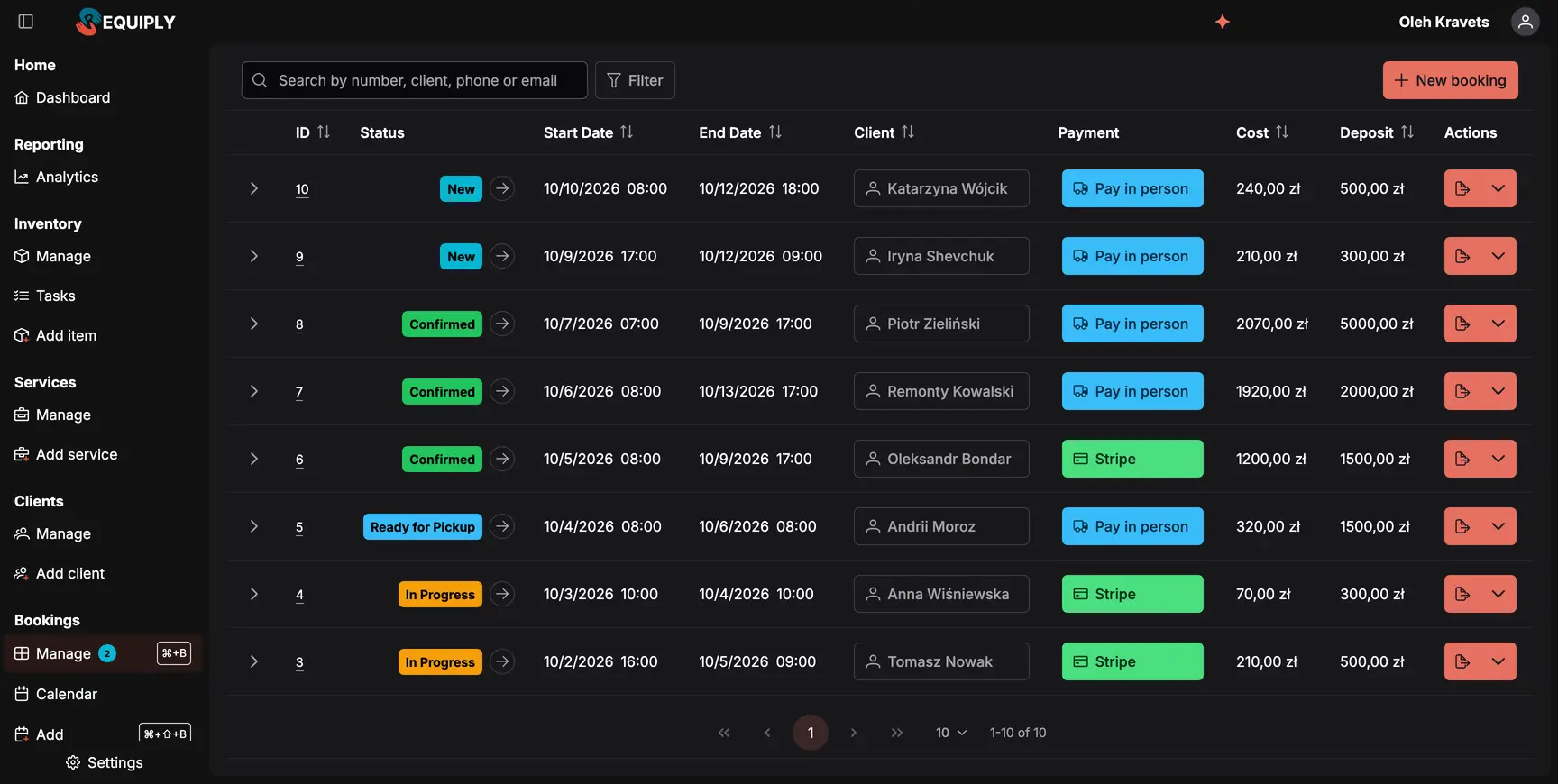
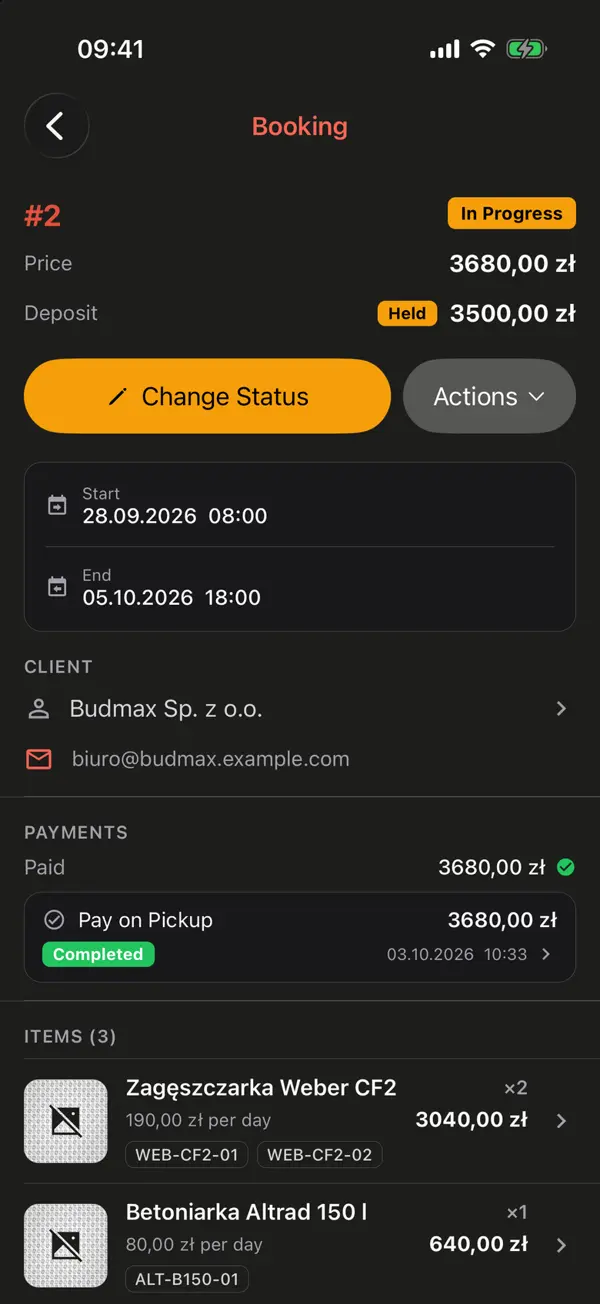
Requiply is rental software we build for small and mid-sized rentals. What it gives a rental in Poland:
- Calendar and bookings with availability checks, so double bookings do not happen
- Prices in złoty, with day, week and month rates
- Online payments through Stripe, where you can turn on BLIK and Przelewy24 next to cards
- Agreements and acts generated from your own templates, in Polish if you write them in Polish
- Inventory by unit, with barcodes and printable labels
- Customer reminders by SMS, email or Telegram
- A client portal where customers book on their own
- iOS and Android apps for handovers and returns in the warehouse
The interface is in English and Ukrainian, there is no Polish version yet. Pricing starts at €16 a month billed yearly (€19 monthly), and the first 14 days are free with no card required. Details are on the pricing page.
Step 7: Find your first clients
Be on Google and OLX
Create a Google Business Profile. It is free, takes half an hour and puts you on Google Maps when people search "wypożyczalnia item city". Then list every category on OLX.pl in the Wypożyczalnia section, with real photos, a specific price and your area.
If you want customers to book without calling, Requiply's client portal gives you a catalog with live availability and online payment, no developer needed.
Channels that work in Poland
- OLX.pl. A must for rentals, people search it first.
- Facebook groups and Marketplace. Local renovation, wedding and parents' groups. Answer questions, do not spam.
- Instagram. Show equipment in action, handovers and reviews, especially for events and photo gear.
- Oferteo. People post requests for event equipment and other services, and you send offers.
- Partnerships. Renovation crews, wedding venues, event agencies, photo studios, mountain guesthouses and campsites can send you customers steadily.
- The Ukrainian community. Telegram channels and Facebook groups of Ukrainians in your city. Service in Ukrainian is a real advantage for crews and families.
How to get customers to come back
- Reminders. A message the day before pickup and on the return day cuts late returns and no-shows. Requiply sends them automatically.
- A discount for regulars. It costs less than ads.
- Reviews. Ask every happy customer for a Google review. In local search, reviews decide who gets the call.
Step 8: Scale
When to buy more equipment
- specific items are above 70% utilization for two months in a row
- you regularly turn customers away because everything is booked
- revenue lets you reinvest 30–50% without hurting cash flow
Once a quarter, look at what earns and what sits idle. Sell what stands still, buy more of what is always out. Analytics in Requiply show revenue and profit per item.
Extra services
- delivery and setup as a paid extra
- an operator for machinery
- consumables: blades, drill bits, sanding discs, batteries. In Requiply a sale is added to the booking and stock is written off automatically.
Working from the warehouse
When handovers come one after another, running back to a computer is a hassle. The Requiply app lets you check items out and in, scan barcodes and change bookings from your phone.


How much can you earn
Revenue = Number of units × Daily rate × Utilization × 30 days
Scenario 1: a small start
- Investment: PLN 10,000–20,000
- Fleet: 10 tools or household items
- Rate: PLN 60 a day
- Utilization: 40%
- Revenue: ~PLN 7,200 a month
- Costs (8.5% ryczałt, health contribution, accountant, listings, repairs): ~PLN 2,600
- Net profit: ~PLN 4,500 a month during ulga na start, ~PLN 4,100 once preferential ZUS starts
- Payback: 3–4 months
Scenario 2: a tool rental with a counter
- Investment: PLN 150,000–250,000
- Fleet: 50 professional tools
- Rate: PLN 90 a day net
- Utilization: 30%
- Revenue: ~PLN 40,500 a month (above PLN 200,000 a year, so you charge VAT)
- Costs (premises, a helper, van, repairs, taxes, ZUS, ads): ~PLN 23,000
- Net profit: ~PLN 17,500 a month
- Payback: 9–14 months
Scenario 3: a full event rental
- Investment: PLN 500,000–1,000,000
- Fleet: tents, hundreds of chairs and tables, lighting, sound
- Revenue: ~PLN 90,000 a month on average (strong May–September, quiet in winter)
- Costs (team, warehouse, vans, repairs, taxes, ZUS): ~PLN 60,000
- Net profit: ~PLN 30,000 a month
- Payback: 2–3 years
These are rough estimates for 2026. Real numbers depend on your niche, city and tax form. Utilization is usually lower in the first months, so keep a buffer.
Common beginner mistakes
1. Starting too broad. Ten rotary hammers and a reputation as the best tool rental in your district earn more than fifty random items.
2. Choosing a tax form without doing the math. Ryczałt is simple, but in a year of heavy equipment purchases the tax scale can be much cheaper.
3. Forgetting the health contribution. Ulga na start removes social contributions, not health. Budget at least PLN 432.54 a month from day one.
4. Taking cash without a register. Once sales to individuals pass PLN 20,000 a year, cash and card payments need a cash register.
5. Agreeing verbally. The first serious dispute without an agreement can cost more than your whole starting fleet.
6. Copying ID cards. Write down the document number instead. Copies without a legal reason or consent break RODO.
7. Not being online. If you are not on Google Maps and OLX, most customers do not know you exist.
8. Tracking by hand for too long. At 20+ items a spreadsheet leads to double bookings, lost orders and money confusion.
Frequently asked questions
Want to see how this looks in practice? Try Requiply free for 14 days or book a short demo. We will help you set it up for your rental.
Starting in Ukraine instead? See How to Start a Rental Business in Ukraine.
Legal note: tax, ZUS and registration details are current as of October 2026 and are a general guide, not tax or legal advice. Rules change, so check biznes.gov.pl, podatki.gov.pl and zus.pl or consult an accountant.
- rental business
- Poland
- JDG
- equipment rental
- how to start
- PKD rental
- ryczałt
- ZUS
- open rental shop
- rental business plan