


To start an equipment rental business in Spain, make sure your residence status lets you work for yourself, pick one niche, register as a self-employed autónomo (or form an SL company if you invest heavily) under the IAE code that matches your equipment, claim the 80 € a month flat-rate contribution for your first year, buy 5–10 of your most requested items, sign every rental with a contract and a deposit, and choose invoicing software that is ready for VeriFactu before it becomes mandatory in 2027. A small tool or household rental can start with 5,000–15,000 €.
Below is a step-by-step plan with Spanish numbers for 2026: residency, registration, taxes, real rental rates and payback. We build Requiply, rental software, so we are not neutral. Rules and prices were checked on 19 October 2026 against the BOE (Spain's official gazette), the tax agency, Social Security and published rental price lists. A glossary of Spanish terms is at the end.
Can a foreigner open a business in Spain
Yes, but your residence status decides how.
- EU, EEA and Swiss citizens. You have the same right to work for yourself as a Spaniard. If you stay longer than three months, register at the Central Register of Foreigners to get your registration certificate and NIE (foreigner identity number). After that, everything in this guide applies to you as written.
- Non-EU citizens already living in Spain. Check your card (TIE). Most residence permits that allow work also allow self-employment. If you have lived in Spain for two years, the arraigo permits (residence based on ties to Spain) are the usual route to a permit that allows work.
- Non-EU citizens moving to Spain to start the business. You apply at a Spanish consulate for a residence and self-employment permit (residencia y trabajo por cuenta propia). You will need a business plan, proof of investment and the qualifications the activity requires. The entrepreneur visa under Law 14/2013 is meant for innovative projects, so a classic rental rarely qualifies.
- Visas that do not fit. The digital nomad visa is for remote work for clients abroad, not for running a local rental. The investor golden visa for property purchases was abolished in April 2025.
Immigration rules change often. Talk to an immigration lawyer before you sign a lease or buy equipment.
Paperwork you will need either way
- NIE and, for non-EU citizens, the TIE card
- A digital certificate or Cl@ve. Almost every filing is online. The FNMT digital certificate is free with an NIE.
- A Spanish bank account. Social Security contributions are collected by direct debit from a SEPA account.
- Sworn translations and apostilles for foreign documents, such as company papers or diplomas
- A driving licence for your equipment. Licences from many countries can be exchanged. Towing heavy trailers needs B96 or BE, and a truck needs C.
Tax residence
If you spend more than 183 days a year in Spain, or your main business or family is here, you are a Spanish tax resident and declare your worldwide income in Spain. Residents with more than 50,000 € in foreign accounts, securities or property in one category also file modelo 720, a declaration of assets abroad. If you keep a business back home, check the double tax treaty with your country before you start.
Is a rental business profitable in Spain
Yes, if your equipment actually goes out instead of sitting in storage. The market helps:
- A big market of small companies. The European Rental Association puts rental of machinery and equipment without an operator in Spain at about 1.5 billion € in 2022, up 11% on the year before (ERA Market Report). Spain's statistics office counts 24,558 rental companies (CNAE 77), and 58% have no employees at all (INE).
- Construction and renovation. About three quarters of equipment rental demand comes from construction. Small crews and homeowners would rather rent a breaker or a lift for one job than buy it.
- Tourism. Spain received a record 96.8 million international visitors in 2025, with more than 11 million a month in July and August (INE). Catalonia, the Balearics and the Canary Islands lead.
- Weddings and events. Spain is a popular destination-wedding market. June, July, September and October hold most of the year's weddings, and each one needs tents, furniture, lighting and sound.
The big chains are here: LoxamHune runs more than 80 branches in Spain and Portugal, including counters inside Leroy Merlin and Bauhaus, Kiloutou runs ToolQuick, and GAM, Boels and mateco cover the industrial side. They mostly serve contractors on industrial estates. Small rentals win with a clear niche, being nearby, weekend hours, delivery and a personal touch.
The number that matters: utilization
Rental profit depends on how much of the time each item is out. 60–70% utilization is already a very good result. Below 30% you barely cover costs, above 80% it is time to buy more.
Example: a 27 kg breaker hammer costs about 1,500 € and rents in Spain for about 70 € a day before IVA. If it is out 15 days out of 30, it brings in about 1,000 € a month and pays for itself in about six weeks.
Step 1: Pick a niche
The most common mistake is buying a bit of everything. Pick one niche and become the most visible rental for it in your town. You can expand later.
| Niche | Starting budget | Typical price (before IVA) | Season |
|---|---|---|---|
| Construction and renovation tools | 5,000–30,000 € | 40–90 €/day | Year-round, peaks in spring and autumn |
| Light machinery (mini excavators, lifts, dumpers) | 40,000–250,000 € | 90–210 €/day | Year-round |
| Event equipment (tents, furniture, light, sound) | 15,000–80,000 € | 150–3,000 €/event | April–October |
| Bikes and sports gear | 10,000–60,000 € | 8–40 €/day | Spring and summer, year-round in the Canaries |
| Photo, video and audio | 10,000–60,000 € | 50–200 €/day | Year-round |
| Household and baby gear | 2,000–10,000 € | 10–40 €/day | Year-round, more in summer in tourist areas |
Prices are indicative and based on 2026 price lists of Spanish rentals (ToolQuick, Kiloutou, Cronoshare, bike rentals in Mallorca, camera rentals in Madrid). There are concrete examples in Step 6.
Niches that fit expat and tourist areas. On the Costa del Sol, the Costa Blanca, the Balearics and the Canaries, a lot of demand comes from visitors and part-time residents: bikes and e-bikes, beach and water sports gear, baby equipment for holiday apartments (cots, high chairs, car seats, strollers) and AV and decor for destination weddings. Boats and motor vehicles need their own licences and insurance, so they are not a light start.
How to check demand before you buy
- Google Maps. Search "alquiler de item en town". Few results or weak reviews mean an opening.
- Milanuncios and Wallapop. Spain's main classifieds sites. Count the rental listings in your area and look at prices.
- Facebook groups. Local renovation groups, expat groups and parents' groups regularly ask where to rent something.
- Competitor bookings. Try to book their popular items for next weekend. If everything is taken, demand is bigger than supply.
Step 2: Choose a legal form, autónomo or SL
| Autónomo (self-employed) | SL (limited company) | |
|---|---|---|
| Setup | Free, online, in a day | About 100 € in notary and registry fees with standard bylaws, 200–1,100 € through an agency |
| Minimum capital | None | From 1 €. Below 3,000 €, 20% of profit goes to a legal reserve |
| Liability | Unlimited, personal | Limited to the company, unless you guarantee its debts |
| Tax on profit | Personal income tax (IRPF), progressive, about 19–47% | Corporate tax: 15% for the first two profitable years, then 19–21% in 2026 for turnover under 1 million € |
| Social Security | 80 € flat rate, then by income | As a director-shareholder, at least about 449 € a month |
| Bookkeeping | Income, expense and asset ledgers | Full accounts filed with the Mercantile Registry |
| VeriFactu deadline | 1 July 2027 | 1 January 2027 |
The express company form (SLNE) that older guides mention was abolished in 2022.
Rule of thumb: start as an autónomo if you are testing a niche with a small investment. Move to an SL once profit passes 40,000–50,000 € a year, when you buy expensive machinery on credit or when a partner joins. Ask a gestoría (the local accounting and admin firm almost every Spanish small business uses) to run both options with your numbers.
What an autónomo pays in 2026
- Flat rate (tarifa plana): 80 € a month for the first 12 months, about 88 € with the MEI surcharge. It can be extended for another 12 months if your net income stays below the minimum wage. You ask for it when you register, and only if you have not been self-employed in the previous two years.
- After that, contributions depend on your monthly net income. Order PJC/297/2026 keeps the 2025 tables, with a total rate of 31.5%:
| Net income per month | Minimum contribution per month |
|---|---|
| Up to 670 € | ~206 € |
| 900–1,166.70 € | ~268 € |
| 1,300–1,700 € | ~303 € |
| 2,030–2,330 € | ~401 € |
| 3,190–3,620 € | ~479 € |
| Over 6,000 € | ~607 € |
You pick a band based on your forecast, and Social Security adjusts it after your annual tax return: you pay the difference or get a refund. Some regions pay the contribution for the first year or two, such as Madrid's Cuota Cero programme.
Step 3: Register with the tax agency and Social Security
Which IAE code to choose
The IAE code tells the tax agency what you do. You declare it on form modelo 036. Rentals of movable goods sit in group 85 of the IAE tariff:
| What you rent | IAE code |
|---|---|
| Construction machinery and equipment (mini excavators, lifts, breakers, scaffolding) | 852 |
| Agricultural machinery | 851 |
| Office and computer equipment | 853 |
| Bicycles | 855.3 |
| Consumer goods: sports gear, household items, event furniture | 856.1 |
| Other movable goods without an operator (professional AV, generators, everything else) | 859 |
You can register several codes at once. Individuals do not pay the IAE tax itself, and companies are exempt for their first two years and while turnover stays under 1 million €. There is also a statistical CNAE code that banks and Social Security ask for. Since 2025 Spain uses CNAE-2025: 77.21 sports goods, 77.22 household goods and DIY tools, 77.32 construction machinery, 77.39 other equipment.
Registration step by step
- Get a digital certificate from the FNMT or a Cl@ve login.
- File modelo 036 with the tax agency: activity, IAE code, premises and VAT regime. The old simplified form 037 was abolished in February 2025.
- Register with Social Security (the RETA scheme for the self-employed) through the Import@ss portal, up to 60 days before you start and always before your first rental. This is where you ask for the flat rate.
- Open a business bank account and set up the direct debit for contributions.
Business support offices (PAE points) register autónomos and companies for free through the government's CIRCE system.
Do you need an activity licence?
If you open premises for customers, you must notify the town hall (ayuntamiento). For premises up to 750 m², Law 12/2012 replaces the prior licence with a simple sworn statement (declaración responsable) for many activities, including bike rental and consumer goods rental. Construction machinery rental (IAE 852) and other equipment (859) are not on that list, so a machinery yard may need a full activity or environmental licence. Check with the town hall before you sign a lease. Working from home with no customers visiting and no stock stored there usually needs no licence.
Step 4: VAT, income tax and invoices
IVA: 21% from the first euro
Spain's VAT, IVA, is 21% on tool, machinery, event and bike rental, with no reduced rates. The Canary Islands use IGIC instead, at a general rate of 7%. You file modelo 303 every quarter and the annual summary modelo 390 in January. A booking advance is taxed when you receive it.
Unlike the UK or many US states, Spain has no small-business VAT threshold: you charge IVA from your first rental. Price consumer rentals with IVA included from day one.
Income tax: no flat-rate scheme
- Real profit only. Equipment rental is excluded from Spain's flat-rate "módulos" scheme, so you are taxed on income minus expenses and depreciation.
- Modelo 130. Every quarter you prepay 20% of your profit so far this year.
- No withholding on your invoices. The 15% withholding Spanish freelancers deal with applies to professional services. Equipment rental is a business activity, so your invoices to companies carry no income tax withholding.
VeriFactu and e-invoicing
- VeriFactu. If you invoice with software, it must meet Spain's rules for invoicing systems, which make every invoice traceable for the tax agency. Mandatory from 1 January 2027 for companies and 1 July 2027 for autónomos (Royal Decree-law 15/2025). The Basque Country and Navarre run their own systems.
- B2B e-invoicing. Electronic invoices between businesses become mandatory from 6 October 2027 for turnover over 8 million € and from 6 October 2028 for everyone else (tax agency calendar).
- Simplified invoices (receipts) are allowed up to 400 € including IVA.
Pick invoicing software that already supports VeriFactu, or let your gestoría issue invoices.
Cash limit
Payments of 1,000 € or more in cash are banned when a business is involved (10,000 € for private customers who are not tax resident in Spain). The fine is 25% of the payment, for both sides. Take large deposits by card or bank transfer.
Accountant
An online gestoría costs about 30–60 € a month for an autónomo and a traditional one 50–120 €, with the annual tax return extra. Companies pay more. Few foreigners do their own Spanish books in the first year, and it is a good place to spend money.
Step 5: Buy your starting inventory
New or used
To test demand, used equipment is often the best start. But condition has to be flawless: a dirty or faulty item damages your reputation faster than anything.
- Wallapop and Milanuncios for used tools, often from businesses that are closing
- Mascus and industrial auctions for used machinery
- Brand distributors if you buy several units
- Leroy Merlin, Bauhaus, Brico Depôt for tools and garden equipment
Insist on CE marking, a declaration of conformity and Spanish-language instructions. Companies that rent from you must use safe work equipment by law, and these are the first documents they ask for. If you import machinery directly from outside the EU, you become the importer and answer for its conformity. The new EU Machinery Regulation applies from 20 January 2027.
Start small and reinvest
Buy 5–10 of whatever people ask for most, and only items that will rent at least 3–4 times a month. In the first months, reinvest 30–50% of revenue in items customers have already asked for.
Subrental when money is tight
You do not have to buy rare items. Rent them from a bigger rental and rent them on with a markup. In Requiply these items are tracked as subrentals: you see the supplier, the status of every purchase and what you made on it after costs.
Funding
- Capitalizing unemployment benefit (pago único): if you are entitled to Spanish unemployment benefit, you can take up to 100% of what is left as a lump sum to invest. Apply before you register as self-employed.
- ICO loans for entrepreneurs, through Spanish banks.
- Leasing for expensive machinery.
- ENISA lends only to companies with innovative projects, so a classic rental rarely qualifies.
Buying an existing rental is also an option, especially in tourist areas where owners retire. You get customers, a fleet and a location at once. Check the fleet's real condition, the lease and whether the IAE codes and licences match what the business actually does.
Step 6: Set prices and deposits
Real rental rates in Spain
Here are published October 2026 rates from ToolQuick, Kiloutou's tool rental network, before IVA:
| Equipment | 24 hours | Week | Deposit |
|---|---|---|---|
| Mini excavator 1.5 t | 204.70 € | 654.90 € | |
| Breaker hammer 27 kg | 69.70 € | 223.10 € | 550 € |
| Generator 20–24 kVA | 85.90 € | 275 € | 700 € |
| One-person lift 9–11 m | 133.90 € | 1,050 € | |
| Tracked mini dumper | 99.80 € | 800 € |
In other niches: a sound system for an event averages 300–500 € a day (Cronoshare), a tent about 5–12 € per m², an e-bike in Mallorca 25–39 € a day and a Sony FX3 cinema camera about 80 € at a Madrid rental.
The pattern in these rates is worth copying, and it differs from what US guides suggest:
- An extra day costs about 80% of the first day. The mini excavator: 204.70 € for day one, 161.60 € for each extra day.
- A week costs about 3.2 daily rates. US guidance usually says 4–5. In Spain the week is cheaper.
- The deposit is about 8 times the daily rate.
- Business prices are quoted before IVA, consumer prices with IVA. Be clear which one you show.
Where to start with the daily rate
For expensive equipment, a handy rule is 1–2% of its value per day. Cheap tools rent for more, often 3–5% of their price, because handing out a drill takes as much time as handing out a plate compactor. Try it with your numbers:
Rental Rate Calculator
The 1–2% rule, applied to your equipment
Per day
30–60
1–2% of value
Per week
≈ 160
×3.5 of the daily rate
Per month
≈ 450
×10 of the daily rate
Estimated revenue per year
4,110 €
Pays for itself in
9 months
Estimates use the middle of the 1–2% corridor. Small tools usually price above it, heavy machines below it. Verify against your real costs and local market prices.
The full cost-based method is in How to Price Equipment Rental.
Day, weekend, week, month
- Weekend: pick up Friday evening, return Monday morning for 1–1.5 daily rates
- Week: about 3–3.5 daily rates
- Month: about 8–10 daily rates
In Requiply you set these rates on an item once, and every booking is priced for you.
Deposits (fianza)
- Expensive items: 50–100% of value, or about 8 daily rates
- Cheap tools: a fixed 50–300 €
- How to take it: a card pre-authorization or a bank transfer, since cash stops at 1,000 €
A deposit held only as security carries no IVA. Kept to cover damage, it is compensation and still carries no IVA. Applied to the rental price or to extra days, it becomes part of the price and IVA applies. Trusted business clients can skip the deposit and pay on 30-day terms.
Seasonality
- Construction: year-round, with peaks in spring and autumn
- Weddings and events: April to October
- Bikes, kayaks and beach gear: Easter to October on the mainland, all year in the Canaries
- Skiing: December to April in Sierra Nevada and the Pyrenees
- Photo and video: steady all year
Delivery
Charge delivery as a separate line, a flat fee per zone or a rate per km. If you hide it in the rental price, you never see what logistics really cost you.
Step 7: Protect your equipment
The rental contract
Rental of goods is covered by Spain's Civil Code (articles 1543 onwards). No official form is required, but always sign a written contract. It should include:
- details of both parties, with a tax ID (NIF or CIF) for companies
- the list of equipment with serial numbers and condition at handover
- the rental period and the price
- the deposit and how it is returned
- permitted use: who may operate the equipment, where, and any hour limits
- liability for damage, loss, theft and late return
- cleaning and fuel
The Civil Code already helps you: the renter is liable for loss or damage unless they prove it was not their fault (article 1563). A clear contract keeps you from having to argue it. Add a handover record with photos at pickup and return, and publish your rental terms on your website. Requiply generates the contract, the handover record and the packing list from the booking in one click, from your own templates, so you can write them in Spanish.
Renting to consumers
- Withdrawal right. A consumer who books at a distance (online or by phone) generally has 14 days to withdraw. The law excludes vehicle rental and leisure services for a specific date, but whether that covers your niche is debatable. Put your cancellation policy in writing and have a lawyer check it.
- Unfair terms. A disproportionate penalty for cancelling or returning late is void against a consumer.
- Complaint forms (hojas de reclamaciones). Businesses serving consumers must keep official complaint forms and display a notice saying so. The model depends on the region.
Identify the customer
Write the type and number of the ID document in the contract. Copying ID cards is not banned, but Spain's data protection agency allows it only when it is necessary and proportionate, and has fined companies for unnecessary copies. For expensive equipment, ask for a higher deposit instead. If you rent motor vehicles, you must also report each rental to the Interior Ministry's SES.HOSPEDAJES system.
Record condition at handover and return
A photo or short video before handover and after return settles most arguments about who damaged what. Requiply has a handover and return checklist where you confirm every unit by hand or by scanning its barcode. If something did not come back, you mark the unit as still out, returned damaged or lost. Leave 2–4 hours between rentals for inspection, and for hourly rentals build that buffer time into the schedule.
Insurance
- Third-party liability insurance is not generally mandatory but you need it: it covers damage your equipment causes to others. For a bike rental, budget roughly 500–2,000 € a year.
- Damage and theft cover for your fleet, including in transit. Put GPS trackers on expensive machinery.
- E-scooters need compulsory insurance from 2026. Standard e-bikes (250 W, assistance up to 25 km/h) do not.
- A damage waiver for customers, priced at 5–10% of the rental, covers small damage and adds revenue.
Machinery rules
- Spanish-language manual, CE marking and up-to-date servicing
- Operators of aerial lifts and forklifts need the matching training
- Self-propelled machinery that drives on public roads needs registration and roadworthiness tests (ITV)
- Supplying an operator turns the rental into a service on a construction site, with extra health and safety duties
Step 8: Payments and tracking
How customers pay in Spain
- Cards: at the counter and online, with pre-authorization for deposits
- Bizum: Spain's instant bank-to-bank phone payments, very common between individuals for small amounts
- Bank transfer: standard for companies, often on 30-day terms
- Cash: still common at the counter, below 1,000 €
Why spreadsheets and chat apps stop working
Almost every rental starts with a spreadsheet and WhatsApp. For 5–10 items that is enough. At 20–30 items you start getting double bookings, forgotten returns, confusion over who paid and where the deposit is, and no idea which items earn money and which just take up space.
Requiply for a rental in Spain
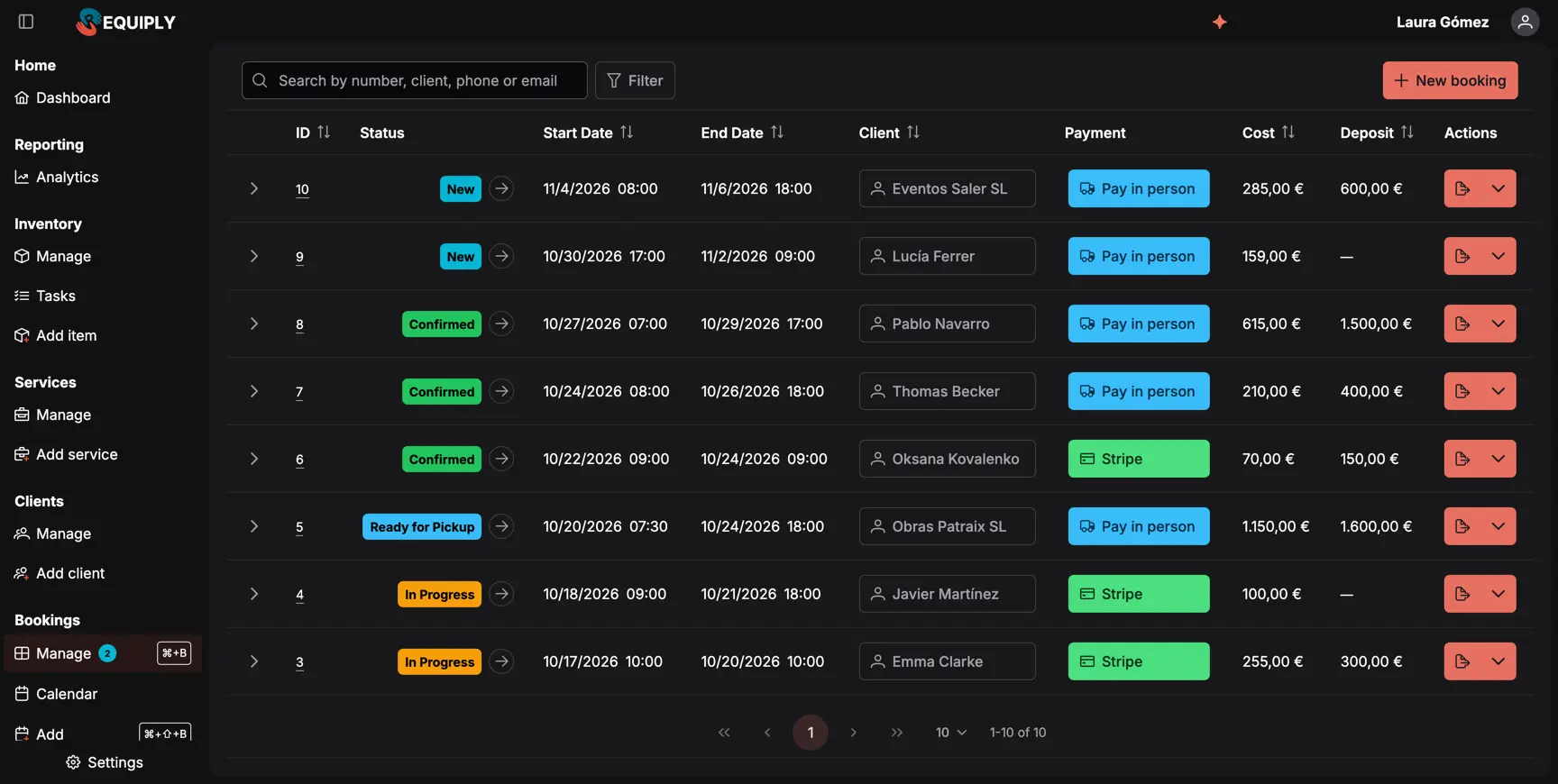
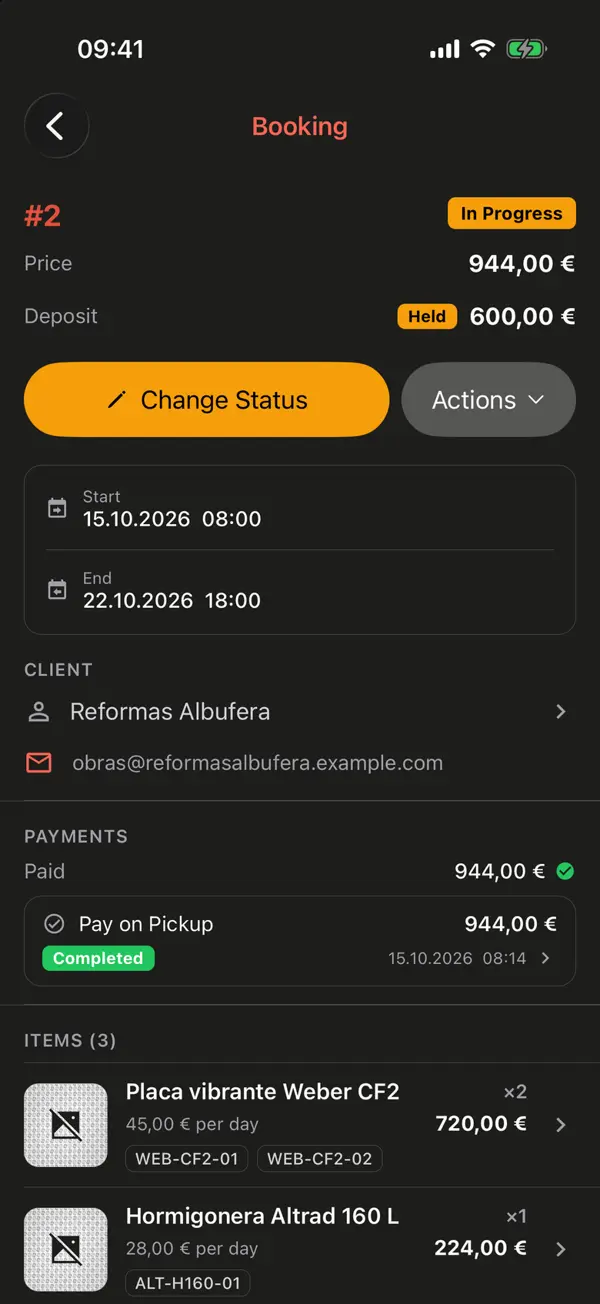
Requiply is rental software we build for small and mid-sized rentals. What it gives a rental in Spain:
- Calendar and bookings with availability checks, so double bookings do not happen
- Prices in euros, with day, week and month rates
- Online payments through Stripe, plus a generic payment system: if you work with another provider, we add it on request
- Contracts and handover records generated from your own templates, in Spanish if you write them in Spanish
- Inventory by unit, with barcodes and printable labels
- Deposits tracked on every booking, separate from the payment
- Customer reminders by SMS, email or Telegram
- A client portal where customers book on their own
- iOS and Android apps for handovers and returns in the warehouse
Requiply is not a VeriFactu invoicing system: issue official invoices in your invoicing software or through your gestoría. The interface is available in Spanish. Pricing starts at 16 € a month billed yearly (19 € monthly), and the first 14 days are free with no card required. Details are on the pricing page. To compare it with other tools, see the equipment rental software buyer's guide.
Step 9: Find your first clients
Be on Google
Create a Google Business Profile. It is free, takes half an hour and puts you on Google Maps when people search "alquiler de item en town". Reviews decide who gets the call, so ask every happy customer for one. List your equipment on Milanuncios with real photos, a price and your area.
If you want customers to book without calling, Requiply's client portal gives you a catalog with live availability and online payment, no developer needed. If you already run a WordPress site, you can connect it to your rental.
Channels that work in Spain
- Builders, renovators and installers near you: visit them with your price list. A trade customer rents every month.
- Wedding planners, wedding venues and event agencies, if you rent event gear.
- Hotels, holiday apartments and campsites, for bikes, beach gear and baby equipment.
- Expat communities, through local Facebook groups and expat associations, especially on the coasts.
- Instagram, to show equipment in action, setups and reviews.
Most of your customers will speak Spanish. At least basic Spanish on your website, listings and contract is a must, even in expat areas.
How to get customers to come back
- Reminders the day before pickup and on the return day cut late returns and no-shows. Requiply sends them automatically.
- A discount for regulars costs less than ads.
- Monthly invoicing for trade accounts.
Step 10: Scale
Buy more when specific items are above 70% utilization two months in a row, you regularly turn customers away, and revenue lets you reinvest 30–50% without hurting cash flow. Once a quarter, sell what stands still and buy more of what is always out. Analytics in Requiply show revenue and profit per item.
Extra services that pay: delivery and setup, an operator for machinery, and consumables such as blades, drill bits, sanding discs and batteries. In Requiply a sale is added to the booking and stock is written off automatically. For handovers in the warehouse, the Requiply app lets you check items out and in and scan barcodes from your phone.


How much can you earn
Revenue = Number of units × Daily rate × Utilization × 30 days
Scenario 1: a small start as an autónomo
- Investment: 6,000–10,000 €
- Fleet: 10 tools or household items
- Rate: 30 € a day before IVA
- Utilization: 40%
- Revenue: ~3,600 € a month
- Costs (flat-rate contribution, gestoría, insurance, repairs, listings): ~600 €
- Profit before income tax: ~3,000 € a month on the flat rate, ~2,700 € after it
- Payback: 3–4 months
Scenario 2: a tool rental with a counter
- Investment: 80,000–150,000 €
- Fleet: 50 professional tools and light machinery
- Rate: 45 € a day before IVA
- Utilization: 30%
- Revenue: ~20,000 € a month
- Costs (warehouse, one employee, van, repairs, insurance, gestoría, contributions, ads): ~7,000 €
- Profit before tax: ~13,000 € a month
- Payback: 10–15 months
Scenario 3: a full event rental
- Investment: 150,000–400,000 €
- Fleet: tents, hundreds of chairs and tables, lighting, sound
- Revenue: ~30,000 € a month on average (strong April to October, quiet in winter)
- Costs (setup crew, warehouse, trucks, repairs, insurance): ~20,000 €
- Profit before tax: ~10,000 € a month
- Payback: 2–3 years
These are rough estimates for 2026. Real numbers depend on your niche, town and legal form, and utilization is usually lower in the first months, so keep a buffer.
Common mistakes
1. Starting before your residence status allows it. Check that your permit covers self-employment before you register or sign a lease.
2. Following an outdated guide. Form 037, the SLNE company and the 60 € flat rate no longer exist. Check numbers on the Social Security and tax agency sites.
3. Forgetting IVA in consumer prices. With no small-business threshold, 21% applies from the first rental. Price without it and you lose a sixth of your revenue.
4. Picking the wrong IAE code. Construction machinery is 852, not 856.1, and that also changes which licence your premises need.
5. Taking large deposits in cash. From 1,000 € it is not allowed. A card pre-authorization is safer for both sides.
6. Renting without a contract. The first serious dispute without one can cost more than your whole starting fleet.
7. Buying machinery without CE documents. Spanish contractors will not rent it, and as the importer you carry the liability.
8. Leaving invoicing for later. VeriFactu arrives in 2027. Choose compliant invoicing software now.
9. Not being on Google Maps. If you are not there, most customers do not know you exist.
Spanish terms you will meet
| Term | Meaning |
|---|---|
| Autónomo | Self-employed person, Spain's sole trader |
| SL (sociedad limitada) | Private limited company |
| NIE / TIE | Foreigner identity number / foreigner identity card |
| RETA | Social Security scheme for the self-employed |
| Tarifa plana | Reduced flat-rate contribution for new autónomos |
| IAE | Business activity tax code, declared on modelo 036 |
| IVA / IGIC | VAT / Canary Islands sales tax |
| IRPF | Personal income tax |
| VeriFactu | Spain's rules for invoicing software |
| Gestoría | Accounting and admin agency |
| Ayuntamiento | Town hall, which handles premises licences |
| Declaración responsable | Sworn statement that replaces a prior licence |
| Fianza | Security deposit |
| Hojas de reclamaciones | Official consumer complaint forms |
Frequently asked questions
Want to see how this looks in practice? Try Requiply free for 14 days or book a short demo. We will help you set it up for your rental.
Comparing countries? See the same guide for Poland.
Legal note: residency, tax, Social Security and invoicing details are current as of October 2026 and are a general guide, not legal, tax or immigration advice. Rules change, so check the tax agency, Social Security and your town hall, or consult a gestoría or lawyer.
- rental business
- Spain
- equipment rental
- start a business in Spain
- autónomo
- Spain as a foreigner
- IAE rental
- VeriFactu
- rental business plan
- equipment rental software